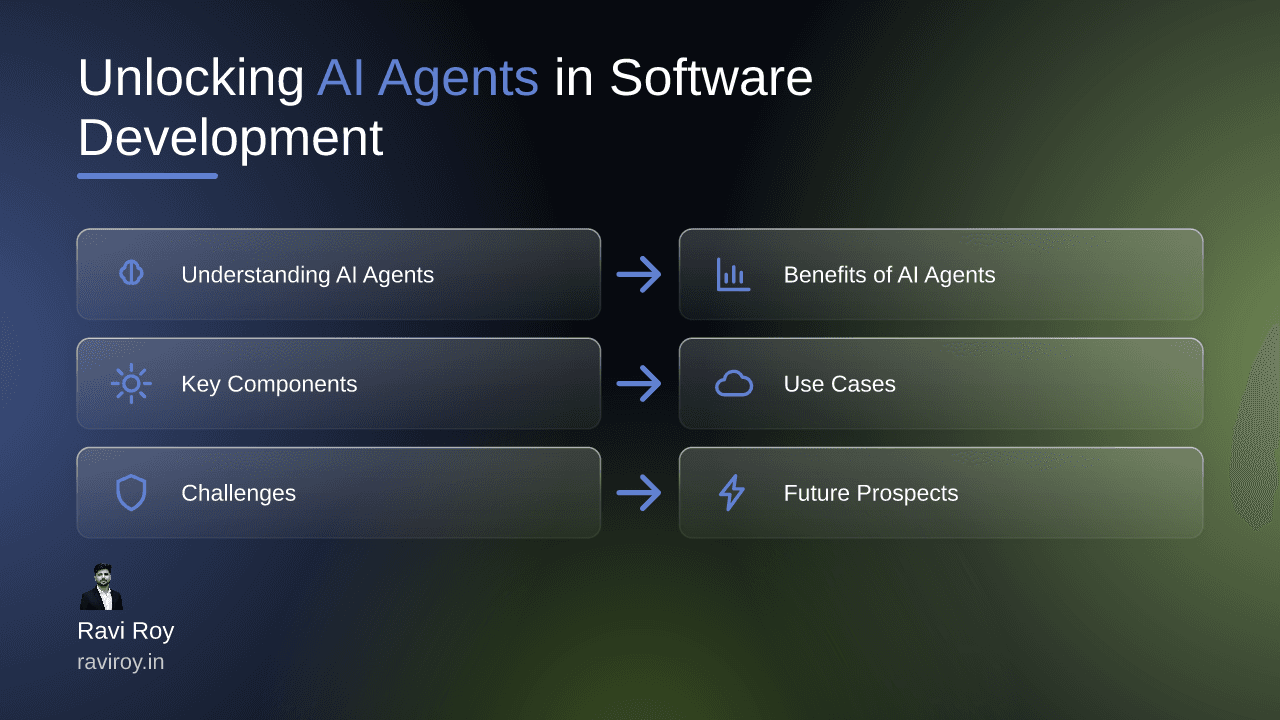
Unlocking the Potential of AI Agents in Modern Software Development
The landscape of software development is shifting rapidly, with AI agents emerging as game-changers in how we approach coding. Imagine a world where your development tasks are not just automated but also enhanced by intelligent tools that anticipate your needs and improve efficiency.
Understanding AI Agents in Software Development
Definition of AI Agents
AI agents in software development refer to autonomous systems that can execute programming tasks typically performed by human developers. They utilize advanced AI techniques to assist with various aspects of the software development life cycle (SDLC), including coding, testing, and deployment. Unlike standard coding tools, AI agents possess the ability to learn from previous interactions, thereby improving their effectiveness over time.
AI Agents vs. Coding Assistants
While both AI agents and coding assistants facilitate the coding process, they serve different roles. Traditional coding assistants are primarily reactive—they provide guidance or suggestions based on user inputs. In contrast, AI agents are proactive, capable of performing tasks autonomously like debugging code or even generating entire modules. This distinction enables AI agents to streamline development processes significantly more than basic coding assistants.
Benefits of Integrating AI Agents into the Software Development Life Cycle
Increased Productivity
One of the most compelling advantages of AI agents is their ability to enhance productivity. In a study conducted by Tech Research Group, teams using AI agents reported a 30% increase in coding efficiency. For example, consider a scenario where AI agents handle code cleanup and refactoring tasks automatically, freeing developers to focus on more creative aspects of their projects. This not only accelerates the development timeline but also leads to quicker time-to-market for software solutions.
Enhanced Code Quality
AI agents also play a crucial role in improving code quality. They can automatically identify and rectify bugs, reducing the likelihood of errors in production. For instance, in an open-source project, an AI agent was deployed to analyze thousands of code commits, resulting in a 40% reduction in bugs reported after release. By continuously learning from past deployments, AI agents refine their debugging algorithms, ensuring a sustainable improvement in code accuracy.
Key Components That Empower AI Agents
Machine Learning Algorithms
At the core of AI agents are sophisticated machine learning algorithms that enable these systems to learn from data and make informed decisions. These algorithms analyze patterns in coding behavior, facilitating predictive capabilities. For example, an AI agent can suggest code optimizations based on historical performance metrics and trends, helping developers write better code faster.
Natural Language Processing
Natural language processing (NLP) is another essential component that makes AI agents user-friendly. With NLP, developers can communicate with AI agents using natural language, making it easier to instruct them to perform specific tasks. Integrated into code repositories and IDEs, NLP enables a seamless interaction, such as asking the agent to "find all instances of deprecated code" or "generate documentation for this module."
Use Cases of AI Agents in Software Development
Automated Testing
One of the most effective applications of AI agents is in automated testing. AI-driven testing tools can simulate various user interactions and automatically validate software functionality under different scenarios. For instance, an e-commerce platform deployed an AI agent that tested their checkout process, identifying and fixing issues that traditional testing methods had overlooked. This not only increased reliability but also saved time in the testing phase.
Code Generation
AI agents excel in code generation, transforming abstract requirements into functional code. Using patterns learned from extensive codebases, they can generate boilerplate code or even entire functions based on high-level descriptions. A notable example includes using AI agents to convert user stories into Python code, allowing development teams to bridge the gap between requirement specification and implementation seamlessly.
Challenges and Risks Associated with AI Agents
Maintainability Issues
While AI agents offer numerous benefits, they also pose maintainability challenges. As software systems become more complex, the integration of AI agents can lead to difficulties in understanding and maintaining the code they produce. Developers must ensure that the architecture surrounding these agents is robust and well-documented to facilitate long-term maintainability.
Security Concerns
The use of AI agents in software development introduces potential security vulnerabilities. If not properly secured, these agents could inadvertently expose sensitive data or allow unauthorized access to critical systems. Techniques such as anomaly detection and access control can help mitigate these risks, ensuring that AI agents operate securely within the development environment.
The Future of AI Agents in Software Development
Agent Orchestrated Development Life Cycle
Looking ahead, the concept of an agent-orchestrated development life cycle is gaining traction. This involves AI agents taking on increasingly complex roles throughout the SDLC, from initial requirements gathering to deployment and monitoring. Future advancements may enable these agents to work collaboratively, learning from one another and facilitating a more integrated development experience.
Evolving Developer Roles
As AI agents become more prevalent, the roles of software developers are set to evolve. While traditional coding skills will remain essential, there will be a greater emphasis on managing AI systems, interpreting their outputs, and integrating them into existing workflows. Developers will transition into roles that require a blend of technical proficiency and strategic oversight, optimizing the collaboration between human expertise and AI capabilities.
Conclusion
AI agents are transforming the software development landscape, offering efficient solutions that enhance productivity and improve code quality. As organizations adapt to this evolving technology, the integration of AI agents serves not just as an upgrade but a complete rethinking of how we approach software development.
What specific challenges have you faced when integrating AI agents into software development, and how did you overcome them?
💬 Join the conversation — share your take in the comments and tell us what you’d add.