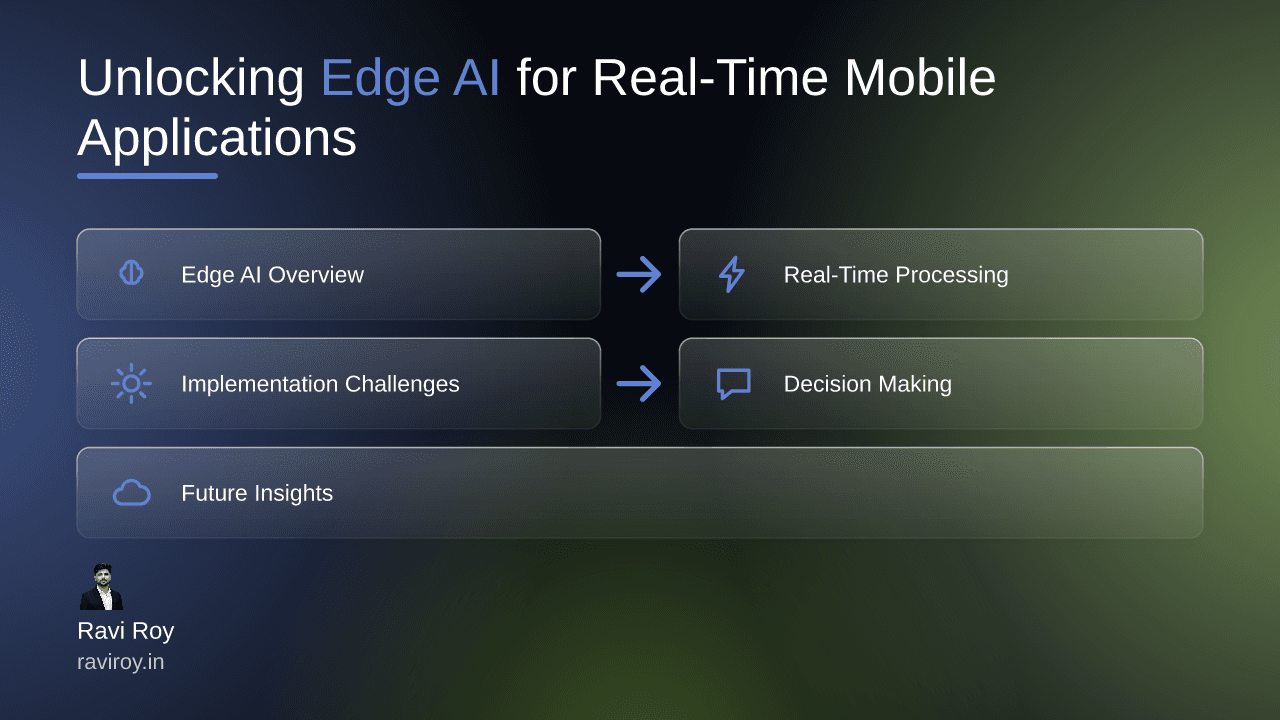
Unlocking Edge AI for Real-Time Mobile Applications: Benefits & Insights
Imagine a world where your smartphone can process vast amounts of data in real-time, making split-second decisions without relying heavily on cloud servers. This isn’t just a futuristic dream; it’s the transformative reality brought by Edge AI in mobile applications. By harnessing the power of local data processing, Edge AI is redefining what’s possible in mobile technology.
What is Edge AI and How Does It Work in Mobile Applications?
Understanding Edge AI
Edge AI refers to artificial intelligence algorithms that are processed locally on devices rather than being routed to data centers or cloud networks. The core principle is optimizing performance by executing AI computations on the device itself. This means that AI is not only closer to the data but can also provide faster responses and enhance user experiences.
How Edge AI Operates in Mobile Apps
In mobile applications, Edge AI operates by using the device's hardware to analyze data and generate insights almost instantaneously. Unlike traditional cloud-based AI, which often suffers from latency due to data transmission times, Edge AI gathers data using built-in sensors, processes it on the device, and makes decisions in real-time. This local processing ensures less downtime and improved functionality, particularly for applications that rely on instant feedback, like augmented reality (AR) or real-time language translation.
Benefits of Edge AI for Real-Time Processing
Improved Speed and Connectivity
One of the most significant advantages of integrating Edge AI with emerging technologies like 5G is the dramatic enhancement in speed and connectivity. With 5G's blazingly fast data transfer rates, applications can operate seamlessly, providing users with an enhanced experience. Whether it’s real-time gaming or streaming high-definition videos, Edge AI enables devices to handle complex calculations swiftly, thus ensuring quicker responses.
For instance, autonomous drones deploy Edge AI to make immediate navigational decisions based on real-time data from their environment, thereby improving safety and efficiency.
Enhanced Privacy and Security
On-device AI represents a boon for privacy. By processing sensitive data locally rather than transmitting it to the cloud, Edge AI reduces vulnerabilities associated with data breaches. Applications in sectors like healthcare, where personal information must be tightly guarded, are leveraging this advantage. For example, health monitoring apps employing Edge AI can evaluate users’ vital signs locally, highlighting anomalies while ensuring that personal data remains private.
The architecture of Edge AI minimizes the risk of data interception during transmission, which is a significant concern for users wary of hacking.
Challenges in Implementing Edge AI in Mobile Applications
Technical Limitations
Despite its advantages, implementing Edge AI comes with obstacles. Energy consumption and thermal management present significant technical barriers. Mobile devices, constrained by their battery life, require highly efficient processing. Excessive heat generated during computation impacts performance and longevity. For instance, current AI models often require extensive computational power that can lead to overheating issues in smaller devices.
Additionally, as app developers continue to push boundaries, they must innovate solutions to ensure energy efficiency without sacrificing processing speed.
Regulatory Challenges
Navigating compliance and regulatory issues can be daunting for developers of Edge AI applications. Different regions have stringent data privacy regulations, such as GDPR in Europe, that dictate how data should be handled. These regulations can constrain how AI learns and processes information, particularly with sensitive user data.
Moreover, the complexities of hybrid edge-cloud models, which leverage both methods to optimize functionalities, present challenges in balancing compliance with performance. Developers must find ways to integrate real-time capabilities while adhering to legal requirements, which often varies across jurisdictions.
Edge AI’s Role in Facilitating Real-Time Decision Making
Real-World Applications
Real-time decision-making is increasingly reliant on Edge AI, particularly in fields such as finance and public safety. Take fraud detection systems that use Edge AI to analyze transaction patterns in real-time; these systems can generate alerts within milliseconds of detecting questionable activities. Similarly, traffic management applications that analyze vehicles and pedestrians in real-time empower cities to optimize traffic flow efficiently.
Offline Functionality
One of the salient features of Edge AI is its ability to function offline. This is especially beneficial in areas with poor connectivity. By analyzing data locally, applications can continue to provide valuable insights without relying on cloud access. For example, offline navigation apps can utilize Edge AI to process map data and provide directions even in remote locations with no cell service. This capability not only enhances user experience but also increases the app’s reliability.
The continuous availability of services fosters user trust and increases the likelihood of sustained engagement.
The Future of Edge AI in Mobile Applications
Advancements in Hardware
As we move forward, advancements in Neural Processing Units (NPUs) will play a pivotal role in the evolution of Edge AI. NPUs are designed to handle AI computations efficiently, enhancing mobile devices' capabilities without draining significant power. The emergence of smartphones equipped with specialized hardware for AI processing will open new avenues for app developers, allowing more complex models to be executed seamlessly.
Collaboration with IoT Devices
The synergy between Edge AI and IoT devices is set to create a new paradigm in mobile applications. As smart home devices become ubiquitous, Edge AI will enable mobile applications to communicate instantly with multiple IoT devices, providing the kind of real-time insights users have come to expect. Picture a smart thermostat that adjusts itself based on real-time analysis of your daily patterns, potentially enhancing energy savings and user comfort.
Such advancements will not only influence app functionality but also reshape consumer behavior and expectations in the mobile ecosystem.
Conclusion
As Edge AI continues to evolve, its impact on real-time mobile applications cannot be overstated. From improved speed and privacy to innovative offline capabilities and hardware advancements, the future looks promising.
What has been your experience with Edge AI in mobile applications? Share specific examples or insights!
💬 Join the conversation — share your take in the comments and tell us what you’d add.