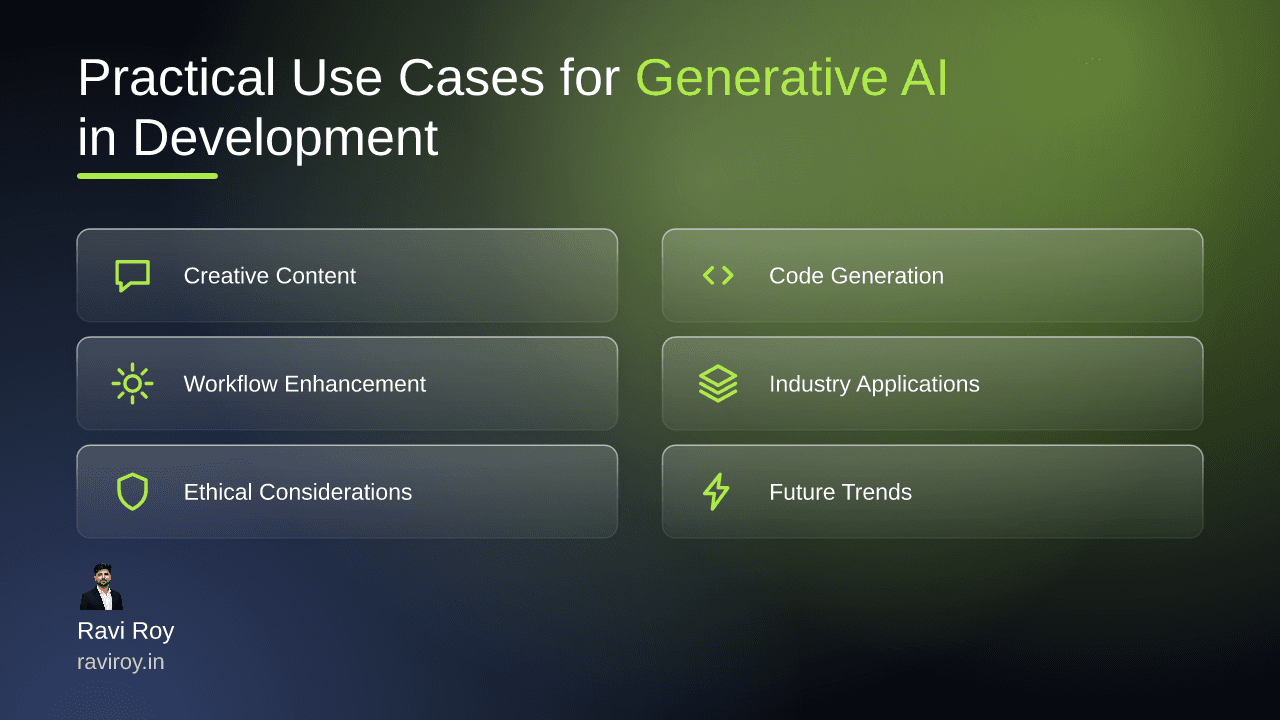
Unleashing Creativity: Practical Use Cases for Generative AI in Development
Understanding Generative AI
What is Generative AI?
Generative AI represents a transformative leap in technology, allowing machines to create content that resembles human-made input. Unlike traditional AI, which typically focuses on recognizing patterns or performing specific tasks, generative AI can produce original written, visual, and audio content based on learned data. Its distinguishing features include creativity and adaptability, enabling the generation of diverse outputs from minimal prompts.
How Does Generative AI Work?
At its core, generative AI leverages large language models (LLMs) and neural networks to interpret and produce data. These models are built on expansive datasets, learning context and relationships between words and concepts. Unlike traditional AI, which relies on pre-defined rules, generative AI employs probabilistic methods, predicting the next element in a sequence or combining existing fragments in novel ways. This flexibility allows it to create unique, contextually relevant material that can enhance various creative processes.
Practical Applications of Generative AI
Creative Content Generation
One of the most impactful applications of generative AI lies in creative content generation. Whether it's writing articles, scripting videos, or composing music, AI tools like OpenAI's GPT-4 can generate written narratives, while systems like DALL-E create visual art from text prompts. For instance, an author can input an outline of a story, and the AI can provide complete chapters, incorporating character development and plot twists seamlessly.
# Example of using a generative AI tool for writing
prompt = "Write a short story about a robot learning to paint."
story = GenerativeAI.generate(prompt)
print(story)
Code Generation and Assistance
Generative AI also transforms software development by assisting in code generation. Tools like GitHub Copilot utilize AI to suggest code snippets, functions, or even entire modules, reducing developers' workload significantly. When encountering complex problems, developers can receive tailored recommendations that not only speed up the coding process but also enhance code quality.
// Example prompt for generating a function with AI assistance
const prompt = "Create a function that sorts an array of numbers in ascending order.";
const ai_code = GenerativeAI.codeSuggest(prompt);
console.log(ai_code);
Personalization in User Experiences
Another exciting application of generative AI is its capacity for real-time personalization. By analyzing user behavior and preferences, AI can tailor experiences, such as showing personalized product recommendations or customized learning paths in educational platforms. This level of personalization enhances user satisfaction and engagement, ultimately driving better retention rates.
Enhancing Developer Workflows with Generative AI
Automating Routine Tasks
Generative AI can handle many routine tasks that consume valuable time for developers. From automating documentation updates to generating repetitive code snippets, AI can significantly streamline these processes. By integrating AI into their workflows, developers can devote more time to strategic thinking and innovation.
Streamlining Collaboration
In team settings, generative AI enhances collaboration by providing intelligent suggestions or supporting communication. Platforms like Slack and Microsoft Teams can integrate AI to summarize discussions, suggest next steps, or even draft responses. This ensures productive communication, enabling teams to focus on critical tasks.
Improving Testing and Debugging
Bug identification and fixing can be taxing in development. Generative AI improves testing processes by automatically reviewing code, identifying potential issues, and suggesting fixes. Tools equipped with AI can learn from past bugs, potentially decreasing the time required for quality assurance before deployment.
Industries Benefiting from Generative AI
Creative Industries
Generative AI has revolutionized creative industries, impacting gaming, film production, and art. AI can suggest plot developments in games, provide visual effects in films, or even design artwork that aligns with specific themes. Companies like Pixar are venturing into AI-assisted design, allowing for unique visual styles that captivate audiences.
Healthcare
In healthcare, generative AI contributes significantly to medical research and diagnostics. By analyzing vast datasets, AI can predict outcomes of treatments, suggest innovative therapies, or assist in drug discovery. AI tools can convert unstructured clinical notes into actionable insights, considerably enhancing patient care.
Finance
The finance industry sees applications in fraud detection, risk assessment, and financial forecasting, with generative AI analyzing patterns within transactions that may indicate fraudulent activity. Banks leverage these technologies to automate reporting and streamline operational processes, boosting efficiency and accuracy.
Ethical Considerations in Using Generative AI
Data Privacy Concerns
As fascinating as generative AI is, it is not without challenges. Using personal data in AI models raises significant privacy concerns. Developers must ensure compliance with regulations like GDPR while handling sensitive information, ensuring users' anonymity and data security.
Bias and Fairness
AI systems can inadvertently perpetuate bias present in training data. Instances of racial or gender bias have emerged in generative AI outputs, prompting calls for greater fairness. Addressing these biases involves continuous monitoring and updating of datasets to reflect more equitable perspectives.
Accountability and Transparency
Accountability in AI decision-making is another crucial ethical concern. Developers must prioritize creating transparent algorithms that clearly articulate how decisions are made. This encompasses making models interpretable and understandable among end-users, reinforcing trust in AI technologies.
Integrating Generative AI into Existing Systems
Strategies for Integration
For developers looking to integrate generative AI, a clear strategy is essential. Initial steps include identifying specific needs, selecting suitable AI tools, and building a robust training dataset. Collaborations with data scientists can enhance model accuracy and alignment with organizational goals.
Challenges in Deployment
Deploying generative AI can encounter several obstacles, including technical limitations, integrating with existing systems, and user adoption issues. Addressing these challenges requires thorough planning, employee training, and ongoing support.
Case Studies and Examples
Real-world examples highlight successful generative AI integration. Companies like Adobe have implemented AI-driven tools that generate design recommendations, leading to a smoother creative process and fostering innovation in design teams. Such case studies can serve as blueprints for future integrations across various industries.
Looking Towards the Future of Generative AI
Upcoming Trends
The future of generative AI is bright, with trends pointing toward hyper-personalization and collaboration. Expect to see advancements in AI that not only enhance creativity but also enable deeper integration into day-to-day workflows, ultimately driving productivity.
Potential Developments in Technology
As technology evolves, the capabilities of generative AI will expand. Emerging tools may allow for real-time collaboration on creative projects or support multi-modal inputs, leading to richer interaction options for users.
New Ethical Standards
As the technology grows, so too must our ethical frameworks. The industry is leaning towards creating standardized ethics around data usage, transparency, and accountability, ensuring the responsible implementation of generative AI solutions.
Generative AI is transforming development and creative processes across various industries. What has been your experience with using generative AI in your projects, and what challenges have you faced?
💬 Join the conversation — share your take in the comments and tell us what you’d add.