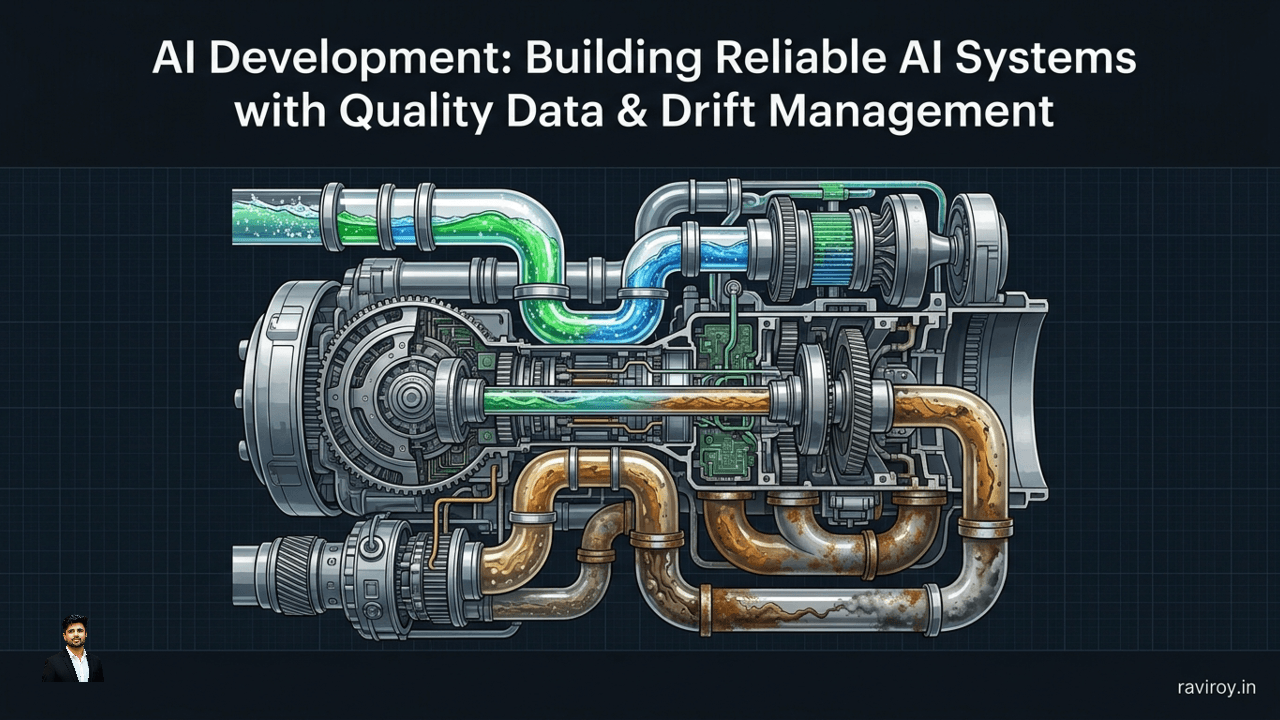
In the dynamic world of artificial intelligence, a groundbreaking model today can quickly become an unreliable liability tomorrow. The true power of AI isn't just in its initial impressive performance, but in its sustained, trustworthy operation within real-world environments. This requires a meticulous approach to AI development, ensuring that systems remain robust and accurate long after deployment. The secret sauce? Unwavering commitment to data quality and proactive management of model drift.
Without these foundational pillars, even the most sophisticated AI systems are prone to performance degradation, biased outputs, and ultimately, a loss of user trust. Building truly reliable AI demands a continuous lifecycle of vigilance, from pristine data pipelines to real-time drift detection and agile remediation.
The Foundation of Trustworthy AI: Data Quality in AI Development
Think of data as the raw material for your AI engine. Just as a combustion engine needs high-quality fuel, an AI model demands high-quality data to function optimally and predictably. Poor data quality isn't merely an inconvenience; it's a critical vulnerability that undermines the entire AI development process.
Why Data Quality Isn't Just 'Good Hygiene' for AI
Ignoring data quality is akin to building a house on sand. Initially, the structure might stand, but it will inevitably crumble under pressure. In AI, poor data quality directly translates into:
Biased Models: If training data disproportionately represents certain demographics or scenarios, the model will inherit and amplify those biases, leading to unfair or inaccurate predictions for underrepresented groups (e.g., a facial recognition system trained predominantly on lighter skin tones performing poorly on darker skin tones).
Performance Degradation: Inconsistent, incomplete, or erroneous data can confuse the model during training, leading to suboptimal learning and reduced accuracy when deployed. A recommendation engine fed with irrelevant purchase history will provide poor suggestions.
Failed Deployments: Models trained on data vastly different from production data, or on data riddled with errors, simply won't perform as expected in the real world, leading to failed deployments and wasted resources.
Key Data Quality Dimensions for AI Development
To build resilient AI systems, we must obsess over several critical data quality dimensions:
Accuracy: Does the data correctly reflect the real-world phenomenon it represents? (e.g., Is a customer's age truly 35, or is it a typo?).
Completeness: Are all expected data points present? Missing values can significantly impair model performance, especially if handled improperly.
Consistency: Is the data uniform across different sources and over time? (e.g., Is "California" sometimes "CA" and sometimes "California"?).
Timeliness: Is the data up-to-date and available when needed? Stale data can lead to outdated predictions, especially in rapidly changing environments.
Representativeness: Does the data accurately reflect the population or process the model is intended to generalize to? Lack of representativeness is a root cause of bias.
Freshness: How recently was the data updated? Crucial for real-time systems.
Label Correctness: For supervised learning, are the target labels accurate and unambiguous? Incorrect labels are direct noise for the learning algorithm.
Implementing Data Observability and Automated Validation
Ensuring high-quality data isn't a one-time check; it's a continuous process powered by data observability and automated validation.
Data Observability provides end-to-end visibility into your data pipelines. Tools in this category monitor data at rest and in motion, tracking schema changes, value distributions, data volume, and freshness. This allows teams to detect trends, identify anomalies (e.g., a sudden drop in expected data volume), and understand the health of their data assets before they impact models.
Automated Data Validation establishes guardrails at critical points.
At Ingestion: Before data even enters your feature store or data warehouse, automated checks can verify schema conformity, data types, value ranges, and uniqueness constraints.
# Conceptual Python snippet for basic data validation
import pandas as pd

def validate_user_data(df: pd.DataFrame) -> bool:
    # Check for expected columns
    expected_columns = ['user_id', 'age', 'country', 'registration_date']
    if not all(col in df.columns for col in expected_columns):
        print("Missing expected columns.")
        return False

    # Check data types
    if not (df['user_id'].dtype == 'int64' and
            df['age'].dtype == 'int64' and
            df['country'].dtype == 'object' and
            pd.api.types.is_datetime64_any_dtype(df['registration_date'])):
        print("Incorrect data types detected.")
        return False

    # Check age range
    if not (df['age'].min() >= 0 and df['age'].max() <= 120).all():
        print("Age outside expected range.")
        return False

    # Check for missing values in critical columns
    if df[['user_id', 'age']].isnull().any().any():
        print("Missing values in critical columns.")
        return False

    print("Data validation passed.")
    return True

# Example usage
# data = pd.read_csv('new_user_registrations.csv')
# if validate_user_data(data):
#     process_data(data)
Pre-Model Training/Inference: More sophisticated checks can be performed, such as monitoring statistical distributions of features (mean, standard deviation, skewness) to ensure they haven't significantly diverged from baseline training data. This catches subtle changes that might not violate basic schema rules but could severely impact model performance.
Understanding and Tackling Model Drift in AI Development
Even with impeccable data quality initially, the real world is constantly changing. This dynamism inevitably leads to "model drift," a phenomenon where an AI model's performance degrades over time because the underlying data it processes, or the relationship it's trying to predict, changes.
Data Drift vs. Concept Drift: A Crucial Distinction
It's vital to differentiate between two primary forms of drift:
Data Drift (or Covariate Shift): This occurs when the statistical properties of the input data (the features
X) change over time, but the relationship between the inputs and the outputs (Y) remains the same.Example: A credit scoring model trained on a population with a stable income distribution. If a recession hits, the income distribution of new loan applicants (input data) might shift significantly lower, even if the fundamental risk factors for default (the concept) remain the same. The model sees input it hasn't been trained on, leading to less reliable predictions.
Concept Drift: This happens when the relationship between the input variables (
X) and the target variable (Y) changes over time. The "concept" the model learned is no longer valid.Example: A fraud detection model trained to identify fraudulent transactions based on certain patterns. Over time, fraudsters evolve their tactics, rendering the old patterns (and thus the model's learned concept) obsolete, even if the incoming transaction data looks superficially similar. Another example is a recommendation engine where customer preferences (the concept of what they like) change with new trends, even if the product catalog (input data) stays the same.
The Silent Threat: How Drift Degrades AI Performance
Untreated model drift is a silent assassin of AI systems. Its effects are often subtle at first, manifesting as:
Stale Predictions: The model's outputs become increasingly irrelevant or outdated, leading to poor decision-making.
Reduced Accuracy and Reliability: The model's predictive power diminishes, resulting in higher error rates, lower precision, or recall.
Business Impact: This can translate directly into financial losses (e.g., mispriced recommendations, inaccurate fraud detection), customer dissatisfaction, and erosion of trust in the AI system. Imagine a medical diagnostic AI suddenly making more incorrect diagnoses due to drift – the consequences are severe.
Early Detection Methods for Proactive Management
Proactive detection is key to mitigating drift.
For Data Drift (Detecting changes in input distributions):
Statistical Distance Metrics: These quantify the difference between two data distributions (e.g., baseline training data vs. recent production data).
Kolmogorov-Smirnov (KS) Test: Compares the cumulative distribution functions (CDFs) of two samples. A high KS statistic suggests a significant difference.
Wasserstein Distance (Earth Mover's Distance): Measures the "cost" of transforming one distribution into another. More robust to outliers than KS.
Population Stability Index (PSI): Often used in credit risk, it measures how much a variable's distribution has changed over time.
# Conceptual Python snippet for KS-test for data drift
from scipy.stats import ks_2samp
import numpy as np

def detect_data_drift_ks(baseline_data, production_data, feature_name, threshold=0.05):
    _, p_value = ks_2samp(baseline_data[feature_name], production_data[feature_name])
    if p_value < threshold:
        print(f"Data drift detected for feature '{feature_name}' (p-value: {p_value:.4f} < {threshold}).")
        return True
    else:
        print(f"No significant data drift for feature '{feature_name}' (p-value: {p_value:.4f} >= {threshold}).")
        return False

# Example: Check drift for 'age' feature
# baseline_ages = np.random.normal(loc=35, scale=10, size=1000)
# production_ages = np.random.normal(loc=40, scale=12, size=1000) # Simulating drift
# detect_data_drift_ks({'age': baseline_ages}, {'age': production_ages}, 'age')
For Concept Drift (Detecting changes in input-output relationships):
Monitoring Model Residuals/Errors: If the model's prediction errors (residuals) start to show a pattern, or their magnitude significantly increases over time, it's a strong indicator of concept drift.
Output Prediction Changes Compared to Ground Truth: Continuously compare model predictions against actual outcomes (ground truth) as they become available. A declining accuracy score (e.g., AUC, F1-score) is a direct sign of concept drift.
A/B Testing (Challenger Models): Deploying a challenger model alongside the current production model and comparing their performance on live data can reveal which model generalizes better to new patterns, signaling concept drift for the incumbent.
Proactive Strategies for Preventing Data and Model Drift
Prevention is always better than cure. Building proactive mechanisms into your AI development lifecycle can significantly reduce the incidence and impact of data and model drift.
Establishing Data Contracts for Upstream Quality
Data contracts are formal agreements between data producers (e.g., application teams, ETL pipelines) and data consumers (e.g., ML teams, downstream analytics). They explicitly define expectations for data quality, ensuring that data arriving at the AI system is fit for purpose. A data contract specifies:
Schema: Column names, data types, nullability constraints.
Format: Encoding, serialization.
Semantic Meaning: Clear definitions of what each column represents.
Quality SLAs: Agreements on completeness, freshness, and accuracy thresholds.
By enforcing data contracts, you create a robust barrier against poor-quality data entering your AI ecosystem, stopping many drift-inducing issues at their source.
// Conceptual Data Contract (JSON snippet)
{
  "dataset_name": "customer_transactions",
  "producer": "payments_service_team",
  "consumer": ["fraud_detection_ml_team", "recommendation_engine_ml_team"],
  "schema": {
    "transaction_id": {"type": "string", "nullable": false, "description": "Unique identifier for the transaction"},
    "customer_id": {"type": "string", "nullable": false},
    "amount": {"type": "float", "nullable": false, "min": 0.01},
    "currency": {"type": "string", "nullable": false, "enum": ["USD", "EUR", "GBP"]},
    "timestamp": {"type": "datetime", "nullable": false},
    "merchant_category": {"type": "string", "nullable": true, "max_length": 50}
  },
  "quality_slas": {
    "freshness": "data available within 5 minutes of transaction",
    "completeness_transaction_id": "100%",
    "completeness_amount": "99.9%",
    "consistency_currency": "enum values only"
  },
  "documentation_link": "http://internal-wiki/transactions-data"
}
Robust MLOps Pipelines: Validation at Every Stage
Integrating automated data validation into your MLOps CI/CD/CT (Continuous Integration/Continuous Delivery/Continuous Training) pipelines is crucial. This means:
Pre-Training Validation: Before any model training run, validate the training dataset against defined quality rules and baselines. If quality checks fail, the training process should be halted or flagged.
Pre-Deployment Validation: Before deploying a new model version, rigorously validate the inference data it will receive and perform consistency checks between training and inference data.
Continuous Monitoring: As discussed, ongoing validation in production to detect drift.
These validation steps act as quality gates, ensuring that only high-quality data and models make it to production.
Leveraging Feature Stores for Consistent Data
A feature store is a centralized repository for managing, serving, and documenting features for machine learning. It's a powerful tool for preventing drift because it ensures:
Consistent Feature Definitions: Features are defined and transformed once, and then reused consistently across both training and inference environments. This eliminates inconsistencies that could arise from different teams or scripts calculating the same feature differently.
Version Control: Features can be versioned, allowing models to be trained and served with specific feature versions.
Reduced Training-Serving Skew: By serving the exact same features to the model in production as were used during training, feature stores significantly reduce the common problem of "training-serving skew," which is a form of data drift.
Real-time Monitoring and Alerting for AI System Health
Proactive detection needs to be coupled with robust monitoring and alerting mechanisms. A healthy AI system isn't one that never drifts, but one that detects drift quickly and effectively.
Key Metrics and Thresholds for Drift Detection
For effective monitoring, you need to track both input data characteristics and model performance.
Metrics for Data Drift:
Statistical measures per feature: Mean, standard deviation, median, skewness, kurtosis.
Distribution comparisons: KS-test p-values, Wasserstein distance, PSI scores.
Categorical feature changes: Unique value counts, top N category shifts.
Missing rates: Percentage of missing values per feature.
Cardinality: Number of unique values for categorical features.
Metrics for Concept Drift (often requiring ground truth or proxies):
Model performance metrics: Accuracy, AUC, F1-score, Precision, Recall, MAE, RMSE (on a sliding window of recent data where ground truth is available).
Prediction confidence: Average or distribution of model's confidence scores. A sudden drop might indicate the model is encountering unfamiliar data.
Residual analysis: Patterns or increases in error magnitudes.
Prediction distribution shifts: Changes in the distribution of the model's output predictions.
Setting Thresholds:
Static Thresholds: Fixed values (e.g., "if AUC drops below 0.85," "if missing rate exceeds 5%"). Simple but can be brittle.
Dynamic/Adaptive Thresholds: Based on statistical control limits (e.g., "if a metric deviates more than X standard deviations from its rolling average"). More robust to natural data fluctuations.
Tools and Platforms for Continuous Monitoring
A range of tools exists to facilitate continuous monitoring:
Open-source Libraries:
Evidently AI: Provides interactive reports and dashboards for data and model drift, data quality, and model performance.
whylogs: Enables lightweight profiling of data to generate statistical summaries, which can then be used for drift detection.
NannyML: Specifically designed for drift detection and impact estimation on performance.
Commercial MLOps Platforms:
Amazon Sagemaker Model Monitor: Integrates with AWS ecosystem, detects data and model quality issues.
Google Cloud Vertex AI Model Monitoring: Similar capabilities within GCP.
Dedicated MLOps Monitoring Solutions: Companies like Arize AI, Fiddler AI, and DataRobot offer advanced monitoring, explainability, and alerting features across various cloud environments.
These platforms often provide customizable dashboards, automated alerts, and the ability to drill down into drift root causes.
Designing an Effective Alerting and Escalation Strategy
Merely detecting drift isn't enough; you need an actionable alerting strategy:
Tiered Alerting:
Minor Anomaly (Informational): Subtle shifts in a non-critical feature distribution. Triggers an internal notification (e.g., Slack channel, email to MLOps team) for awareness.
Significant Drift (Warning): Clear drift in a critical feature or a noticeable drop in a secondary performance metric. Triggers a higher-priority alert (e.g., PagerDuty, direct team notification) requiring investigation.
Critical Failure (Urgent): Severe concept drift, primary performance metric drop below critical threshold, or major data pipeline failure. Triggers an immediate, high-priority alert to on-call engineers, potentially initiating automated remediation.
Defined Escalation Paths: Clearly outline who is responsible for responding to each alert tier and how alerts escalate if not addressed within a specified timeframe.
Context-Rich Alerts: Alerts should contain enough information (e.g., which model, which feature, current vs. baseline distributions, affected metrics) to enable quick diagnosis.
The Model Remediation Playbook: Responding to Drift Events
Once drift is detected, a well-defined remediation playbook is essential to restore model performance and stability.
When and How Often to Retrain AI Models
Retraining is the most common response to drift, but the timing and frequency are crucial:
Scheduled Retraining: Regularly retrain models (e.g., weekly, monthly) regardless of detected drift. Simple to manage but can be resource-intensive and might retrain unnecessarily or too late.
Performance-Based Retraining: Trigger a retraining when key performance metrics (e.g., AUC, F1-score) drop below a predefined threshold in production. Direct and reactive, but requires timely ground truth data.
Drift-Based Retraining: Initiate retraining specifically when significant data or concept drift is detected. This is generally the most efficient approach, retraining only when necessary.
Considerations for retraining include the cost (compute, data labeling), speed required, and the availability of fresh, labeled data. Often, a hybrid approach combining scheduled and drift-based triggers is optimal.
Automated Rollback and Version Control for Stability
Model versioning and the ability to roll back are non-negotiable for reliable AI systems. If a newly deployed model exhibits unforeseen issues or if a retraining effort exacerbates drift, a quick rollback to a previously stable version can prevent prolonged outages.
Model Registry: Maintain a central repository of all trained model versions, metadata, performance metrics, and the data they were trained on.
Automated Rollback: Implement mechanisms within your MLOps pipeline that can automatically revert to a previous model version if monitoring systems detect critical failures shortly after a new deployment or retraining.
Closing the Loop: Feedback and Continuous Improvement
Remediation isn't just about fixing the immediate problem; it's about learning and preventing recurrence. Establish robust feedback loops:
Root Cause Analysis: For every significant drift event, conduct a thorough analysis to understand its root cause (e.g., upstream data pipeline change, market shift, new user behavior).
Data Labeling & Annotation: If ground truth data is scarce, a drift event might trigger an accelerated data labeling project to gather fresh, representative data for retraining.
Pipeline Adjustments: Insights from drift events should feed back into improving data contracts, enhancing data validation rules, or adjusting feature engineering processes. This continuous cycle of detection, analysis, and improvement is the hallmark of mature AI development.
Ensuring Trust and Governance in AI Development
Reliability goes hand-in-hand with trust and ethical governance. AI systems must not only perform well but also operate transparently and responsibly.
Data Lineage and Metadata for Transparency
Data Lineage: Tracing data from its original source through all transformations, feature engineering steps, to its final consumption by the model. This provides an audit trail crucial for debugging, understanding model behavior, and complying with regulations.
Comprehensive Metadata: Documenting everything about your data and models: feature definitions, transformation logic, model architecture, training parameters, evaluation metrics, and deployment history.
Metadata helps explain why a model made a particular prediction and what data influenced it, fostering transparency.
Embedding Governance into MLOps Workflows
Governance shouldn't be an afterthought but an integrated part of your AI development lifecycle:
Compliance Checks: Automate checks for regulatory compliance (e.g., GDPR, HIPAA for data privacy) within your MLOps pipelines.
Ethical Guidelines: Integrate checks for fairness and bias detection. For example, monitor model performance across different demographic groups and flag significant disparities before deployment.
Bias Detection: Tools can analyze training data for imbalances or test models for discriminatory outcomes across sensitive attributes. These checks should be part of pre-training and pre-deployment gates.
The Future of Reliable AI: Generative and Agentic Systems
As AI evolves into more sophisticated forms like generative and agentic systems, new dimensions of data quality and drift management emerge.
New Dimensions of Drift for Generative AI
Generative models (e.g., LLMs, image generators) introduce unique challenges:
Output Coherence Drift: The generated text or images might become less coherent, logical, or relevant over time as underlying data distributions shift or the model's internal state degrades.
Style Drift: A generative model might subtly change its output style or tone (e.g., from formal to informal, or artistic to utilitarian), impacting brand consistency or user experience.
Factual Hallucination Drift: Language models might start generating more incorrect or fabricated information, especially if the knowledge base they rely on becomes stale or corrupted.
Safety/Bias Drift: The model might start generating outputs that are toxic, biased, or harmful, even if initially fine-tuned for safety.
Data Quality Challenges for Agentic AI
Agentic AI systems, which operate autonomously and interact with environments, face novel data quality hurdles:
Synthetic Data Quality: Agentic systems often rely heavily on synthetic data generated for training in simulated environments. The quality, realism, and representativeness of this synthetic data are paramount.
Prompt Engineering Robustness: The prompts and instructions given to agents are a form of input data. Drift in how users phrase prompts, or if the agent's interpretation of prompts changes, can lead to performance degradation.
Interaction Data Fidelity: Agents learn from their interactions. Ensuring the high fidelity and unbiased collection of this interaction data is critical to prevent the agent from learning undesirable behaviors or biases.
Building reliable AI systems isn't a destination; it's a continuous journey of diligent data quality management, proactive drift detection, and agile remediation. From foundational data contracts to the cutting-edge challenges of generative and agentic AI, the principles of vigilance and continuous improvement remain paramount for ensuring trustworthy AI development.
What strategies have you found most effective in detecting and mitigating subtle model drift in your production AI systems? Share your experiences and any tools you rely on in the comments below.
💬 Join the conversation — share your take in the comments and tell us what you’d add.