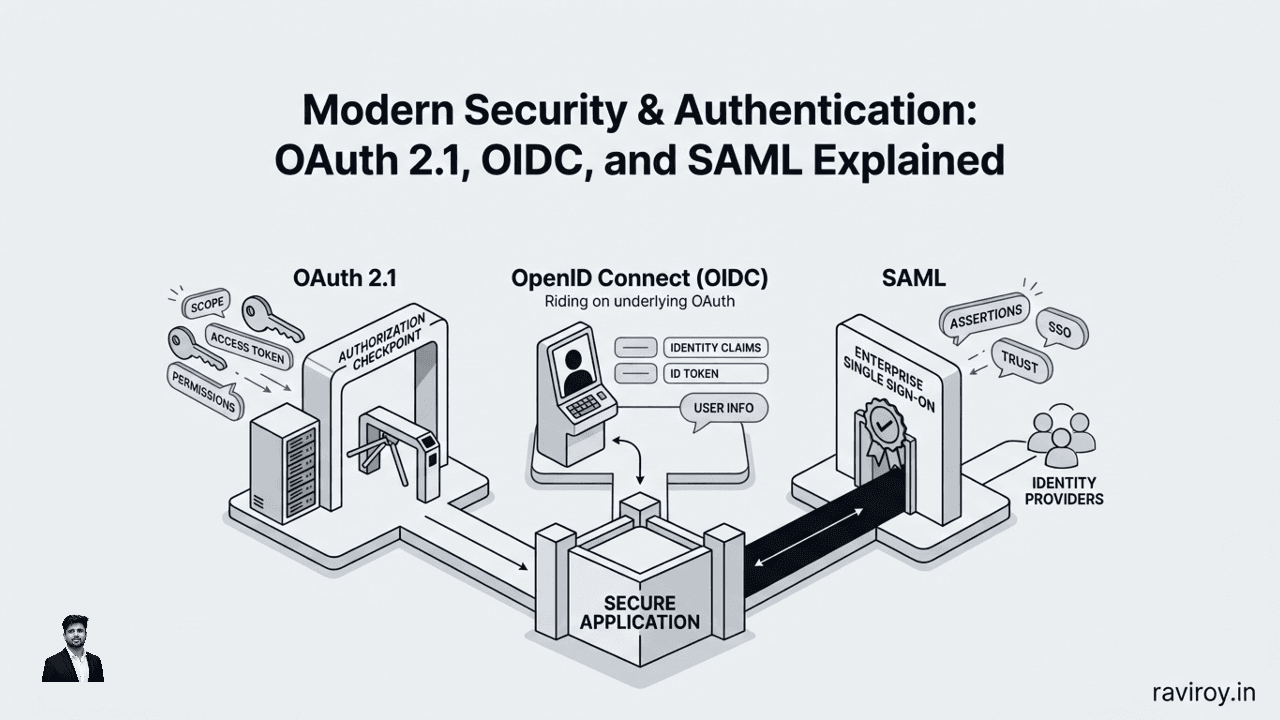
The landscape of application security is more complex than ever, with new threats emerging daily and user expectations for seamless, secure access continually rising. Building robust digital experiences hinges on selecting the right Modern Security & Authentication protocols, a task that often leaves even seasoned developers feeling overwhelmed. Navigating the nuances between OAuth 2.1, OpenID Connect, and SAML can be a significant hurdle, leading to architectural decisions that might compromise security, scalability, or developer experience.
This guide aims to cut through that confusion, providing a clear framework to understand these critical protocols. We'll demystify their roles, illuminate their strengths and weaknesses, and equip you with the knowledge to make informed choices for your next project, ensuring your applications are not just functional but fundamentally secure.
Navigating Modern Security & Authentication Flows
In the digital realm, trust is paramount. Every interaction, from logging into a banking app to sharing photos with friends, relies on robust mechanisms to verify identity and control access. This is where modern security and authentication protocols step in, acting as the silent guardians of your digital ecosystem. Yet, with a proliferation of standards and ever-evolving threats, choosing the correct approach can feel like deciphering an ancient script.
Many teams grapple with distinguishing between OAuth 2.1, OpenID Connect (OIDC), and SAML, often misapplying them or overlooking crucial security implications. Our goal here is to clarify the purpose and interplay of these foundational technologies, offering a practical decision framework to guide your architectural choices for secure, efficient, and scalable identity and access management.
OAuth 2.1: The Authorization Foundation
At its core, OAuth 2.1 is an authorization framework, not an authentication protocol. Its primary purpose is to enable an application (the "Client") to obtain limited access to an HTTP service (the "Resource Server") on behalf of a user (the "Resource Owner"). Think of it as a valet key for your car: you give it to the valet so they can park your car, but not drive it home or open your glove compartment.
The OAuth 2.1 framework defines four key roles:
Resource Owner: The user who owns the protected resources (e.g., their photos on a social media site).
Client: The application requesting access to the Resource Owner's protected resources (e.g., a photo editing app).
Authorization Server: The server that authenticates the Resource Owner and issues access tokens to the Client.
Resource Server: The server hosting the protected resources, capable of accepting and validating access tokens.
Crucially, OAuth 2.1 explicitly does not provide authentication itself. It’s solely focused on delegated permission. An access token, issued by the Authorization Server, is a bearer token – whoever possesses it can access the specified resources. OAuth 2.1 is an evolution of OAuth 2.0, refining its security posture by making best practices (like PKCE for public clients) mandatory and deprecating insecure flows. This enhancement means a more secure and consistent implementation standard.
OpenID Connect (OIDC): Your Modern Authentication Layer
While OAuth 2.1 handles authorization, the question of "who are you?" is answered by OpenID Connect (OIDC). OIDC is an identity layer built on top of the OAuth 2.1/2.0 framework. Its primary purpose is user authentication and identity verification. It allows Clients to verify the identity of the end-user based on the authentication performed by an Authorization Server, as well as to obtain basic profile information about the end-user in an interoperable and REST-like manner.
OIDC achieves this through the ID Token, a security token that contains claims about the authentication event and the user. The ID Token is a JSON Web Token (JWT) – a compact, URL-safe means of representing claims to be transferred between two parties. It is digitally signed by the Authorization Server, allowing the Client to verify its authenticity and integrity. Typical claims in an ID Token might include:
iss(issuer): Identifies the OpenID Provider.sub(subject): Unique identifier for the end-user at the issuer.aud(audience): Identifies the client that the ID Token is intended for.exp(expiration time): Time after which the ID Token cannot be accepted.iat(issued at time): Time at which the ID Token was issued.auth_time: Time when the authentication occurred.name,email,picture: Optional profile information (if requested and consented).
The lightweight, JSON-based nature of OIDC makes it incredibly well-suited for modern web applications, Single Page Applications (SPAs), and mobile apps, offering a significant advantage over SAML's more verbose XML structure. In essence, OIDC answers the implicit question left by OAuth: "Can OAuth 2.1 be used for authentication?" The answer is no, but OIDC adds that crucial identity layer on top of OAuth's robust authorization capabilities.
SAML: The Enterprise SSO Stalwart
Before OIDC became the de facto standard for modern web authentication, SAML (Security Assertion Markup Language) was—and in many enterprise contexts, still is—the king of Single Sign-On (SSO). SAML's primary purpose is to enable enterprise-grade SSO, particularly for web browsers, allowing users to authenticate once with an Identity Provider (IdP) and gain access to multiple Service Providers (SPs) without re-entering credentials.
SAML operates by exchanging XML-based "assertions" between the IdP and the SP. When a user tries to access a resource at an SP, they are redirected to the IdP for authentication. After successful authentication, the IdP generates a SAML assertion (an XML document containing identity and authentication information) and sends it back to the SP, often via the user's browser. The SP then validates the assertion and grants access.
SAML's maturity means it has a long history of use in B2B integrations, government sectors, and large enterprises with existing legacy infrastructure. When you encounter a system that requires integration with an established corporate directory or a partner's complex identity management system, SAML is frequently the mandated protocol. Its robust XML signature and encryption capabilities have made it a trusted choice for situations demanding strict compliance and audit trails. Despite the rise of OIDC, SAML remains the best choice when integrating with existing SAML-compliant Identity Providers or when specific contractual or regulatory requirements dictate its use.
Disentangling Authentication vs. Authorization
The most common point of confusion in security protocols is the difference between authentication and authorization. While often used interchangeably, they serve distinct purposes:
Authentication answers the question: "Who are you?" It's the process of verifying a user's identity. When you log in with a username and password (or a biometric scan, or a multi-factor code), you are authenticating.
Authorization answers the question: "What are you allowed to do?" Once your identity is verified, authorization determines what resources or actions you have permission to access. For example, a user might be authenticated, but only authorized to view certain pages, not edit them.
Here's how OIDC and OAuth 2.1 fit into this distinction:
OIDC focuses squarely on authentication. It's about establishing who the user is. The result of a successful OIDC flow is an ID Token which verifiably states the user's identity and confirms they've been authenticated by the identity provider. Additional user details can be fetched from the
UserInfoendpoint.OAuth 2.1 focuses solely on authorization. It's about granting an application permission to act on behalf of the user, without sharing the user's credentials directly with the application. The output is an Access Token (and often a Refresh Token). The Access Token is used by the client to access protected resources on the Resource Server. The Resource Server validates this token to ensure the application is authorized for the requested action.
Consider a typical flow:
A user attempts to log into a mobile application.
The application redirects the user to an Authorization Server (which also acts as an OpenID Provider).
The user authenticates with the Authorization Server (e.g., enters username/password, completes MFA). This is the authentication step, handled by OIDC.
Upon successful authentication and user consent, the Authorization Server issues an ID Token (for authentication) and an Access Token (for authorization) to the mobile application.
The mobile application validates the ID Token to confirm the user's identity.
The mobile application then uses the Access Token to make requests to a backend Resource Server (e.g., to fetch user data, post content). The Resource Server validates the Access Token and, if valid, grants the application permission to access the user's resources. This is the authorization step, handled by OAuth 2.1.
This clear separation of concerns ensures that identity verification (OIDC) is decoupled from resource access delegation (OAuth 2.1), leading to more secure and modular architectures.
The Modern Standard: Authorization Code Flow with PKCE
In the evolving landscape of security protocols, not all flows are created equal. The Authorization Code Flow with Proof Key for Code Exchange (PKCE) has emerged as the unequivocal standard for securing modern applications.
Why PKCE is Non-Negotiable
PKCE (pronounced "pixie") is a critical security enhancement initially designed for public clients like native mobile apps and Single Page Applications (SPAs) where client secrets cannot be securely stored. It has since become the recommended best practice for virtually all client types using the Authorization Code flow.
Here’s why PKCE is so important:
Mitigates Authorization Code Interception: In the traditional Authorization Code flow, if a malicious attacker intercepts the authorization code (e.g., via a compromised browser or DNS redirection), they could exchange it for an access token. PKCE prevents this by requiring the client to demonstrate proof of ownership of the authorization request when exchanging the code for a token.
How it Works:
The client generates a cryptographically random
code_verifierand acode_challengederived from it.The
code_challengeis sent with the initial authorization request.The Authorization Server stores this
code_challenge.When the client receives the authorization code and exchanges it for a token, it must also send the original
code_verifier.The Authorization Server re-derives the
code_challengefrom the providedcode_verifierand compares it to the one stored earlier. If they don't match, the token exchange is denied.
This process effectively binds the authorization request to the token request, ensuring that only the original client that initiated the flow can complete it, even if an attacker intercepts the authorization code. OAuth 2.1 makes the use of Authorization Code + PKCE the default and recommended flow for almost all modern client types, including server-side web applications (where it enhances security against specific attack vectors, even if a client secret is used).
Deprecated Flows and Why
To fully embrace modern security, it's equally important to understand and actively abandon outdated and insecure OAuth 2.0 flows. These flows have known vulnerabilities that make them unsuitable for new development and ripe for migration in existing systems.
Implicit Flow: In this flow, the access token is returned directly in the URL fragment after user authentication.
Vulnerability: This token can easily be leaked through browser history, referrer headers, or logging. It also prevents the use of refresh tokens and typically requires shorter-lived access tokens. OAuth 2.1 explicitly forbids the Implicit flow.
Resource Owner Password Credentials Grant: This flow allowed the client application to request the user's username and password directly, which the client then sent to the Authorization Server to get an access token.
Vulnerability: This is an anti-pattern as it requires the client to handle (and potentially store) the user's sensitive credentials, creating a huge attack surface for phishing and credential theft. It completely bypasses the security benefits of delegated authorization. OAuth 2.1 explicitly forbids the Resource Owner Password Credentials Grant.
Client Credentials Flow (misused for user authentication): While a valid flow for machine-to-machine (M2M) authentication, it is sometimes incorrectly used for user authentication.
Vulnerability: This flow is designed for services to authenticate themselves with an API, not for a user to authenticate with an application. It does not provide any user context or authentication, only client authentication.
By understanding why these flows are deprecated, developers can avoid common pitfalls and build more resilient and secure applications.
Choosing Your Protocol: A Decision Framework
Selecting the right authentication and authorization protocol depends heavily on your application's architecture, target users, and integration requirements.
For Modern Web & Mobile Applications
For Single Page Applications (SPAs), native mobile applications, and Backend-for-Frontend (BFF) architectures, the clear recommendation is OIDC built on OAuth 2.1, specifically utilizing the Authorization Code Flow with PKCE.
SPAs and Mobile Apps: These are "public clients" that cannot securely store a client secret. PKCE is mandatory here, preventing authorization code interception. OIDC provides the identity layer (who the user is), and OAuth 2.1 grants permission to access APIs on behalf of that user.
Backend-for-Frontend (BFF): A BFF acts as a confidential client, securing the tokens server-side and exposing a simplified API to the public client. Even with a BFF, using PKCE for the initial public client-to-BFF communication enhances security.
Example Flow (SPA/Mobile with OIDC & OAuth 2.1 + PKCE):
User clicks "Login" in SPA/Mobile app.
App generates
code_verifierandcode_challenge, then redirects browser to Authorization Server withcode_challenge.User authenticates with Authorization Server.
Authorization Server redirects browser back to app with
authorization_code.App sends
authorization_codeandcode_verifierto Authorization Server's token endpoint.Authorization Server validates
code_challengefromcode_verifier, issuesID Token(authentication) andAccess Token(authorization).App uses
ID Tokento identify user andAccess Tokento call protected APIs.
For Enterprise (B2B) SSO and Legacy Systems
When integrating with existing enterprise identity providers (IdPs) or mandated by legal/contractual obligations, SAML often remains the best choice.
Existing IdP Ecosystems: Many large organizations, particularly in government, finance, or healthcare, have significant investments in SAML-based identity management systems. Migrating these can be costly and disruptive.
B2B Integrations: When you need to provide SSO for your customers who use their own corporate IdP, SAML is a mature and widely supported protocol for this purpose.
Specific Compliance: Certain industry regulations or client contracts may explicitly require SAML.
While OIDC is gaining traction in enterprise environments due to its modern appeal, SAML's deep roots and robust XML security features continue to make it a relevant option for specific B2B and legacy integration scenarios.
For Machine-to-Machine (M2M) API Authorization
For scenarios where no user context is involved, such as server-to-server communication, background services, or scheduled tasks accessing APIs, OAuth 2.1's Client Credentials flow is the appropriate choice.
No User Interaction: A service (the client) authenticates itself directly with the Authorization Server using its own client ID and client secret (which must be securely stored).
Scoped Access: The Authorization Server issues an access token to the service, granting it specific permissions to access resources on another service (the Resource Server). There is no "user" to consent to anything; the client is the principal requesting access.
Example Flow (M2M with OAuth 2.1 Client Credentials):
A background service needs to call an API.
The service securely presents its
client_idandclient_secretto the Authorization Server's token endpoint.Authorization Server validates credentials and issues an
Access Tokento the service.The service uses the
Access Tokento call the protected API.The API validates the
Access Tokenand grants access based on the scopes defined for that service.
Choosing the right protocol based on client type, integration partners, and required features ensures that your system is both secure and efficient.
Enhancing Security & Best Practices Across Protocols
Regardless of the primary protocol you choose, several overarching security best practices are crucial for protecting your applications and users.
General Security Practices
Secure Token Storage:
Access Tokens: For public clients (SPAs, mobile apps), store in memory or secure local storage (e.g., HTTP-only cookies, device secure storage) for short durations. Avoid
localStoragedue to XSS risks.Refresh Tokens: For confidential clients (server-side apps, BFFs), store refresh tokens securely on the server side, encrypted at rest. For public clients, use rotating refresh tokens with sender-constrained tokens, and consider secure-flagged, HTTP-only cookies.
Short-Lived Tokens & Token Rotation: Access tokens should have a short lifespan (e.g., 5-60 minutes) to minimize the window of opportunity for attackers if a token is compromised. Use refresh tokens (with proper security mechanisms like token rotation and sender-constrained tokens) to obtain new access tokens without re-authenticating the user.
Strict Client Registration & Verified Redirect URIs: Always ensure that client applications are properly registered with the Authorization Server and that all redirect URIs are explicitly whitelisted. The Authorization Server must enforce strict matching of redirect URIs to prevent phishing and code/token interception attacks.
Robust Key Management: Securely generate, store, and rotate cryptographic keys used for signing ID Tokens, encrypting SAML assertions, and protecting client secrets. Hardware Security Modules (HSMs) or cloud-managed key services are highly recommended.
Protocol-Specific Security Posture
OIDC (with PKCE): Its JSON Web Token (JWT) structure allows for efficient digital signatures and encryption. Coupled with PKCE, strict token validation (checking
iss,aud,exp, signature), and HTTPS across all communication, OIDC offers a highly secure and modern authentication flow suitable for public clients.SAML: Relies heavily on XML digital signatures and XML encryption for securing assertions. The complexity of XML processing and signature validation requires careful implementation to avoid vulnerabilities. While robust, its verbosity can sometimes make it harder to debug and implement correctly compared to OIDC's JSON.
Additional Web Application Security Measures
Content Security Policy (CSP): Implement a strict CSP to mitigate XSS attacks by controlling which resources the browser is allowed to load. This can prevent malicious scripts from stealing tokens.
Cross-Origin Resource Sharing (CORS): Properly configure CORS headers on your API and Authorization Server to restrict which origins can make cross-origin requests, preventing unauthorized access to your resources.
HTTPS Everywhere: All communication (authorization requests, token exchanges, API calls) must occur over HTTPS to protect against eavesdropping and man-in-the-middle attacks.
By adopting these best practices, you can significantly enhance the security posture of your applications, regardless of the chosen authentication and authorization protocols.
Migrating to Modern Security & Authentication Standards
The journey to modern security often involves transitioning from older systems. While daunting, phased migration strategies can minimize disruption and significantly uplift your security posture.
From SAML to OpenID Connect
Migrating from a SAML-based identity system to OIDC can offer benefits like simplified development, better compatibility with modern application architectures (SPAs, mobile), and a more lightweight protocol.
Migration Strategy:
Inventory & Assess:
Identify all applications currently using SAML.
Determine which SAML Identity Provider (IdP) is being used.
Assess the level of effort required for each application to adopt OIDC.
IdP Compatibility:
Check if your existing SAML IdP also supports OIDC. Many enterprise IdPs (e.g., Okta, Azure AD, Auth0) are multi-protocol and support both. This is often the easiest path.
If not, consider introducing a new OIDC-compliant IdP or proxying the SAML IdP through an OIDC gateway.
Application Updates (Phased):
Start with new applications or less critical legacy applications.
Update application code to use OIDC client libraries for authentication.
Simultaneously support both SAML and OIDC during a transition period (e.g., using different login buttons or redirect paths).
Configure your OIDC Provider with appropriate scopes (e.g.,
openid profile email) and redirect URIs for your applications.
User Experience & Communication:
Plan how user accounts will be migrated or linked between the old and new systems.
Communicate changes to users well in advance, explaining new login experiences or any temporary disruptions.
Decommission SAML: Once all applications and users have successfully transitioned to OIDC, decommission the old SAML integrations and infrastructure.
Upgrading OAuth 2.0 to OAuth 2.1
Upgrading existing OAuth 2.0 implementations to OAuth 2.1 primarily involves adopting stronger security profiles and eliminating deprecated flows.
Practical Steps:
Audit Existing Flows:
Identify all OAuth 2.0 flows currently in use across your client applications.
Specifically, pinpoint any use of the Implicit Flow or the Resource Owner Password Credentials Grant.
Prioritize PKCE Adoption:
For all public clients (SPAs, mobile apps) using the Authorization Code flow, make PKCE mandatory. This might involve updating client-side libraries and configuration on the Authorization Server.
Even for confidential clients (server-side web apps), adopting PKCE with the Authorization Code flow is a recommended best practice for defense in depth.
Eliminate Deprecated Flows:
Implicit Flow: For SPAs, migrate to Authorization Code Flow with PKCE. This might require introducing a Backend-for-Frontend (BFF) or a proxy if direct client-side token exchange is not feasible due to CORS or secure storage concerns.
Resource Owner Password Credentials Grant: Migrate applications using this to Authorization Code Flow with PKCE. This is a critical security upgrade.
Review Client Registration:
Ensure all client applications have properly registered
redirect_urisandpost_logout_redirect_urisand that strict validation is enforced.Verify that
response_typevalues are limited tocode(for Auth Code flow) and nottoken(for Implicit flow).
Incremental Rollout: Implement changes incrementally, testing thoroughly with a subset of clients or environments before rolling out broadly. This minimizes disruption and allows for quick remediation of issues.
By taking these proactive steps, organizations can significantly improve their security posture, simplify their identity management, and align with the latest industry best practices in Modern Security & Authentication.
What challenges have you encountered when migrating authentication protocols, or what specific architectural decisions led you to choose OAuth 2.1, OIDC, or SAML for your most recent project?
💬 Join the conversation — share your take in the comments and tell us what you’d add.