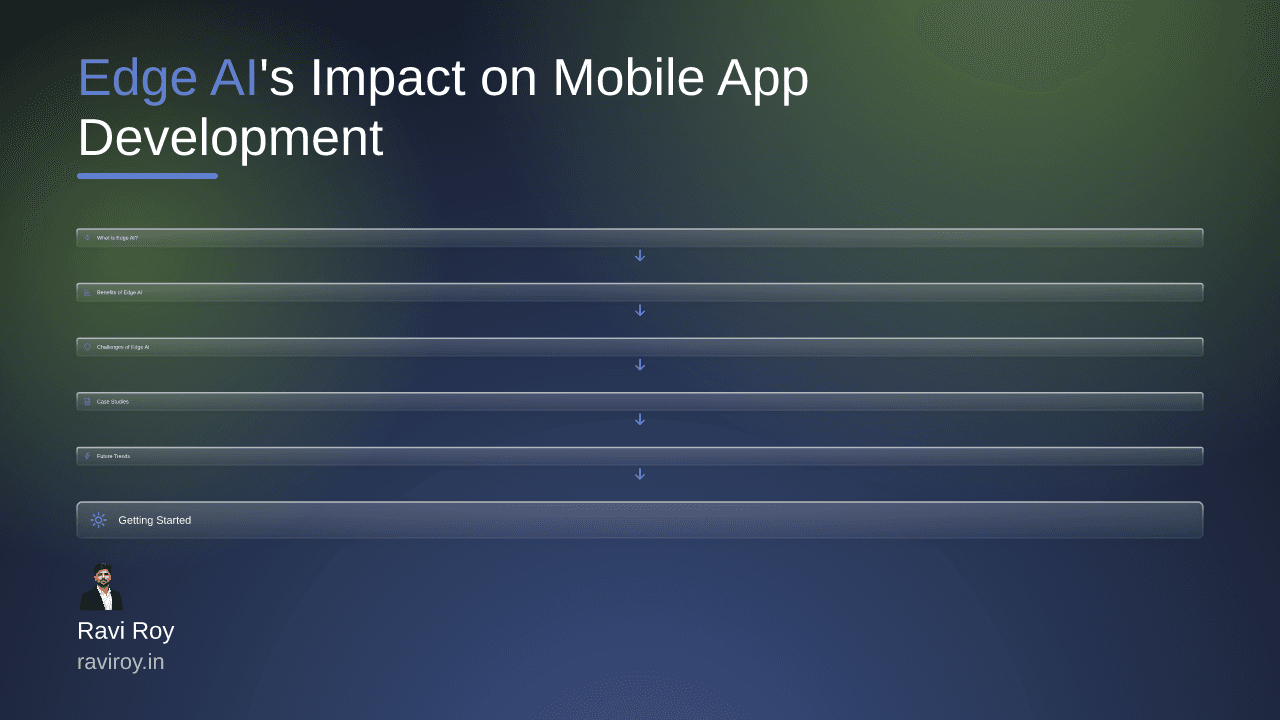
What is Edge AI and How is it Transforming Mobile App Development?
Edge AI represents a revolutionary shift in mobile app development, enabling applications to process data locally on devices rather than relying solely on cloud computing resources. This paradigm shift brings real-time capabilities and enhances performance, with far-reaching implications for users and developers alike.
Defining Edge AI
Edge AI combines edge computing and artificial intelligence, offering the ability to analyze data closer to its source. This means rather than sending data to a centralized server for processing, mobile devices can make decisions based on the information they collect in real-time. The primary functions of edge AI include data analysis, machine learning model execution, and inference, all performed directly on the device itself.
The Convergence of AI and Edge Computing
The intersection of AI and edge computing opens the door for numerous advanced applications. By minimizing latency, edge AI enhances the responsiveness of mobile apps significantly. For example, consider a mobile app for facial recognition. With edge AI, the app can process images locally, achieving faster identification without the need for constant communication with the cloud. Applications like augmented reality games also benefit tremendously; users experience smooth interactions as a result of real-time data processing.
Benefits of Implementing Edge AI in Mobile Applications
The adoption of edge AI in mobile apps brings along a plethora of benefits that directly enhance user experience and app performance.
Enhanced User Experience
One of the standout advantages of edge AI is its ability to deliver highly personalized experiences. By processing data on the device, apps can tailor content and functionality based on usage patterns, preferences, and real-time context. For instance, a fitness app can analyze a user’s performance metrics to suggest customized workouts, ensuring a more engaging and relevant experience.
Improved Security and Privacy
Security is paramount in mobile app development, and edge AI provides a robust framework for enhancing data protection. By keeping sensitive information on the device rather than transmitting it to the cloud, edge AI reduces vulnerability to data breaches. For example, apps that handle biometric data, such as fingerprint or facial recognition, can process this information securely on the device itself, minimizing the risk of exposure.
Faster Data Processing
Speed is critical in mobile applications, and edge AI helps to achieve responsive interactions. Apps that require rapid decision-making—such as navigation apps that update in real-time—can utilize edge AI to analyze data locally. A prime example is a mapping app that adjusts routes based on live traffic data, processing this information in seconds directly on the user’s device.
Challenges and Considerations of Edge AI in Mobile App Development
While the advantages of edge AI are compelling, there are significant challenges that developers must navigate in pursuit of these innovations.
Technical Challenges
Integrating edge AI into mobile applications presents various technical obstacles, such as limited computational resources on devices. Developers often need to optimize AI models for efficient performance and ensure that the app can function seamlessly across diverse hardware. Moreover, building applications that can handle fluctuating connectivity while still processing data locally requires thoughtful engineering.
User Adoption and Understanding
For edge AI to be effective, users must understand its advantages. Many users still view cloud computing as the default, leading to potential hesitance to adopt mobile apps that leverage edge AI capabilities. Therefore, developer education and user-friendly interfaces are essential to communicate the benefits of edge AI clearly.
Legal and Compliance Issues
Legal considerations are also paramount when it comes to using edge AI, particularly in handling personal and sensitive data. Developers must ensure compliance with data protection regulations such as GDPR, especially since some data processing occurs locally. This requires an understanding of regulations and ensuring users are informed about how their data is used.
Case Studies: Successful Mobile Apps Utilizing Edge AI
Examining real-world applications can illustrate the transformative impact of edge AI in mobile development.
Smart Home Applications
Smart home apps have embraced edge AI to enhance automation and efficiency. For example, security systems that use facial recognition can process images on-site, triggering alerts without relying on cloud processing. This not only speeds up responses but also elevates security and privacy.
Healthcare Mobile Solutions
In the healthcare sector, mobile apps that utilize edge AI for patient monitoring have shown remarkable success. For instance, wearable devices paired with mobile platforms can analyze health metrics in real-time, providing immediate feedback to patients and health professionals alike. This has profound implications for chronic disease management, enabling proactive care.
Autonomous Vehicle Apps
Autonomous vehicle applications heavily rely on edge AI for real-time decision-making. By processing data from sensors immediately, these apps ensure that vehicles can respond to their environment with minimal latency, enhancing safety and performance. An example is a mobile navigation app that integrates real-time traffic data, allowing vehicles to navigate safely and efficiently.
Future Trends: The Growth of Edge AI in Mobile Development
Looking forward, the growth of edge AI in mobile development will likely be driven by emerging technologies and evolving industry needs.
Emerging Technologies
New technologies, such as advancements in 5G, will significantly impact edge AI's adoption in mobile apps. With increased bandwidth and lower latency, developers can push the limits of what edge AI can achieve, allowing for even more complex computations and faster responses in real-time applications.
Predictions for Edge AI Adoption
As awareness grows, predicting the future of edge AI indicates a significant increase in adoption rates among developers and businesses. Companies that integrate edge AI into their mobile app strategy are likely to gain a competitive edge, leading to a quicker transition in the industry as technological maturity aligns with enhanced user expectations.
Getting Started with Edge AI in Your Mobile App Development
To begin leveraging edge AI, developers need to equip themselves with the right tools and frameworks.
Tools and Frameworks
There are several key tools and frameworks developers can use for integrating edge AI. Some popular options include TensorFlow Lite, which is optimized for mobile devices, and AWS IoT Greengrass, allowing you to run local compute, messaging, data caching, and sync capabilities. Additionally, frameworks like Apache MXNet provide efficient communication for on-device training.
Best Practices for Implementation
For successful edge AI implementation, developers should adopt best practices such as optimizing models for device performance, ensuring battery efficiency, and maintaining comprehensive testing to handle diverse scenarios. Furthermore, providing users with clear benefits and educational content about edge AI’s functionalities will enhance their experience and promote adoption.
What challenges have you faced when considering Edge AI in your app development? Share your experiences, insights, and ideas in the comments. Let's explore the future of mobile app development together!
💬 Join the conversation — share your take in the comments and tell us what you’d add.