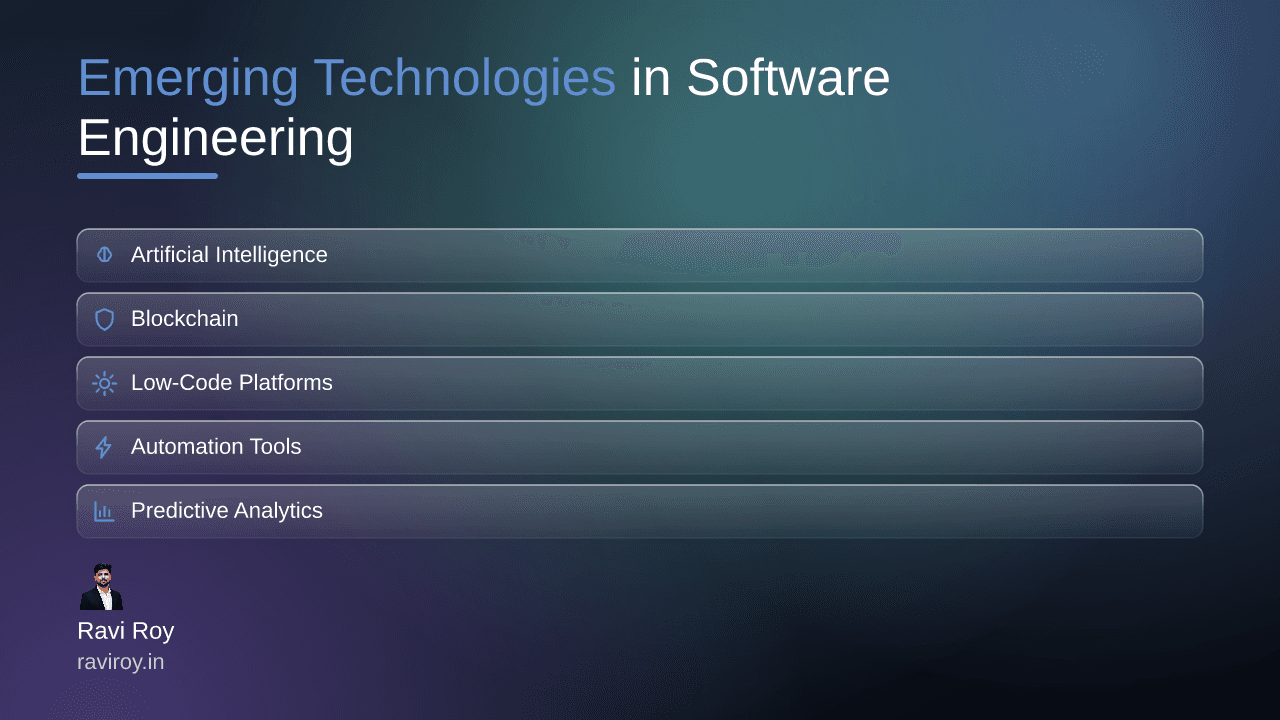
Introduction to Emerging Technologies in Software Engineering
The landscape of software engineering is evolving at an unprecedented pace, driven by a slew of emerging technologies that reshape how we design, build, and maintain applications. Emerging technologies in this realm encompass innovations such as artificial intelligence (AI), blockchain, low-code platforms, and more. These tools are not just trends; they are essential for modern software development, pushing practitioners to adapt or risk obsolescence.
As AI and automation technologies evolve, they introduce new paradigms of efficiency and creativity in coding practices and project management. Staying updated with these tech trends isn't merely a choice; it's a survival skill in the competitive tech arena.
Key Emerging Technologies Shaping Software Development
Artificial Intelligence and Machine Learning
AI and machine learning are no longer futuristic concepts; they're integral to today's software development. These technologies redefine coding practices by automating repetitive tasks, predicting bugs, and recommending features based on user behavior. For instance, platforms like GitHub Copilot leverage AI to assist developers in writing code, increasing productivity and reducing the chances of errors.
Moreover, AI impacts project management through predictive analytics that help teams anticipate project challenges before they arise, thus streamlining workflows. This amalgamation of intelligence not only optimizes the coding process but also aligns teams more closely with business goals.
Blockchain Technology
Blockchain technology plays a pivotal role in enhancing security and transparency in software applications. By providing decentralized and tamper-proof ledgers, it mitigates risks related to data breaches and fraud. For software engineers, integrating blockchain means rethinking how data is stored and managed.
Take, for example, applications in supply chain management. By employing a blockchain solution, stakeholders can track products in real-time, ensuring every transaction is verified and recorded securely. Companies like IBM are already utilizing blockchain to improve trust and accountability across various sectors, demonstrating its transformative capabilities.
Low-Code and No-Code Platforms
Low-code and no-code platforms are democratizing software development by enabling users without extensive coding knowledge to create functional applications. These platforms, such as OutSystems and Bubble, allow for rapid prototyping and deployment, significantly reducing development time.
By leveraging drag-and-drop features, more people can participate in the software development process, allowing specialized knowledge (like marketing or product management) to flow into the product more effectively. This shift not only empowers teams but also fosters innovation, as ideas can be easily transformed into prototypes.
The Integration of AI in Software Engineering Workflows
As organizations increasingly adopt AI, its integration into software engineering workflows becomes critical. Here’s how:
Automated Code Generation
Tools for automated code generation, like Tabnine or DeepCode, offer developers the ability to generate code snippets or even entire functions based on simple prompts. This drastically reduces the amount of boilerplate code developers must write, allowing them to focus on more complex tasks.
Intelligent Testing and Debugging
AI-driven testing tools, such as Test.ai, use machine learning to identify patterns in code that may lead to bugs. By automating the debugging process, these tools enhance the quality of software and reduce the time spent on manual testing. Imagine deploying code with higher confidence because AI has already scanned and optimized it!
AI-Powered DevOps
AI is revolutionizing CI/CD (Continuous Integration/Continuous Deployment) pipelines by predicting deployment failures and offering improvement suggestions. Tools like Harness.ai use machine learning to analyze historical deployment data, which can significantly improve deployment success rates.
Challenges and Considerations of Implementing Emerging Technologies
While the benefits of emerging technologies are clear, challenges exist that organizations must navigate.
Learning Curve and Skill Development
The rapid advancement of technology places immense pressure on engineers to continuously learn. As new tools emerge, so too does the necessity for upskilling. Organizations can mitigate this by providing regular training sessions and encouraging professional development.
Ethics and Responsibility in AI
The deployment of AI raises ethical concerns, particularly surrounding data privacy and algorithmic bias. Companies must be proactive in establishing ethical guidelines and frameworks to ensure their AI systems operate fairly and transparently.
Integrating New Tools with Legacy Systems
Integrating emerging technologies with legacy systems can pose significant challenges. The complexity of these older systems often requires careful planning and execution to avoid disruptions. Strategies like phased rollouts or utilizing APIs can ease this transition, but they require significant foresight.
Future Trends in Software Engineering Driven by Emerging Technologies
Looking ahead, several emerging technologies hold promise for revolutionizing software development further.
Quantum Computing
Quantum computing could drastically change how we approach problem-solving within software engineering. Its potential to perform complex calculations at speed currently unimaginable could redefine entire sectors, though practical applications are still on the horizon.
Edge Computing
With the need for real-time data processing growing, edge computing is set to impact software significantly. By processing data closer to the source, it reduces latency and bandwidth, making it ideal for IoT applications and real-time analytics.
Augmented Reality and Virtual Reality
AR and VR are enhancing user experiences by creating immersive environments that allow for interactive applications. As these technologies become more integrated into software, developers will need to adapt their design philosophies to create more engaging and intuitive interfaces.
Conclusion: Embracing Change in Software Engineering
Adapting to emerging technologies is not just advantageous; it is essential for the future success of software engineering. By staying informed and proactive in learning, developers can harness these innovations to drive productivity and foster a culture of continuous improvement.
What emerging technologies have you successfully integrated into your software engineering practices, and what challenges did you face?
💬 Join the conversation — share your take in the comments and tell us what you’d add.