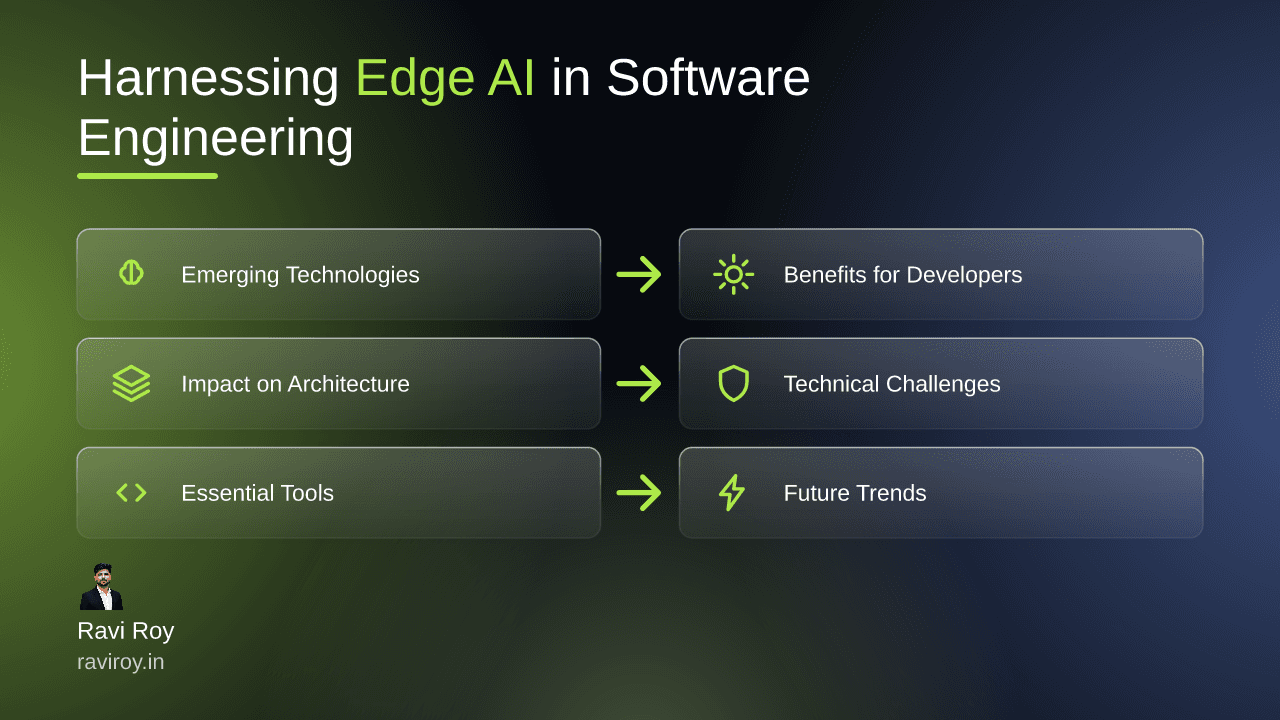
Harnessing Emerging Technologies: Edge AI in Software Engineering
Understanding Emerging Technologies in Software Engineering
What are Emerging Technologies?
Emerging technologies refer to novel systems and tools that significantly influence various sectors, especially software development. They embody the latest innovations designed to enhance efficiency and effectiveness in engineering processes. Emerging technologies, including artificial intelligence (AI), machine learning (ML), and blockchain, hold immense potential and are rapidly evolving to address complex challenges in the software landscape.
In this context, Edge AI plays a pivotal role. It combines traditional AI capabilities with the computational power located at the edge of the network, allowing for real-time data processing and decision-making. By utilizing data close to the source, Edge AI reduces latency, enhances user experience, and optimizes performance in critical applications (like IoT devices).
The Importance of Edge AI
The evolution of Edge AI marks a critical transformation in how software engineering operates. As software systems expand, the need for instantaneous data processing becomes paramount. Edge AI provides this capability by processing data locally on devices rather than relying solely on centralized cloud resources. This local data handling not only enhances performance but also introduces greater resilience in system design.
Moreover, Edge AI has manifested itself as a necessary innovation for industries facing a deluge of data. From healthcare, where immediate processing can mean life or death, to smart cities, where connectivity and data management are essential, the implications are profound.
The Benefits of Edge AI for Developers
Improved Performance
One of the standout features of Edge AI is its ability to deliver enhanced performance through real-time data processing. Unlike traditional cloud-based systems with inherent latencies, Edge AI empowers applications by ensuring that data is processed immediately where it is generated. For instance, consider a self-driving car that relies on Edge AI to interpret sensor data and make rapid decisions about obstacles and routing. This level of immediacy is crucial for safety and capability.
Additionally, the capacity for Edge AI applications to function with intermittent internet connectivity broadens their applicability across various environments—whether urban, rural, or remote. Developers are therefore given the tools to craft applications that are not only faster but also more robust.
Enhanced Privacy and Security
Data privacy and security continue to be primary concerns for software developers. Edge AI brings local data handling directly into the spotlight, significantly alleviating many associated risks. As fewer data packets are transmitted to the cloud, the attack surface for potential breaches is drastically reduced.
Take the healthcare sector as an example. By processing patient data locally on devices, hospitals can maintain high standards of privacy while ensuring rapid responses to urgent situations. This dual advantage creates healthier systems in a digital age where data sovereignty is increasingly essential.
Impact of Edge AI on Software Architecture
Shifts in Design Principles
Software architecture is experiencing a paradigm shift as Edge AI solutions become integral. The traditional model of centering applications around cloud resources is transforming into a distributed architecture that balances processing power at both the edge and the cloud.
This hybrid architecture ensures optimal performance but requires developers to rethink design principles. For instance, applications must be designed to operate autonomously on the edge while seamlessly syncing with the cloud for data retrieval and more extensive analytics.
Interoperability Considerations
With the rise of Edge AI, interoperability becomes crucial. It’s not sufficient for devices to function independently; they must also integrate fluidly with other systems. In practice, this means ensuring that devices across various environments, from smart homes to industrial settings, can communicate effectively without disruption.
Challenges here include managing consistency in performance across varied hardware and networks. Developers must prioritize standardized protocols and platforms to facilitate this communication, which directly influences the robustness of the final deployment.
Technical Challenges in Developing Edge AI Applications
Scalability Issues
One of the significant challenges in developing Edge AI applications lies in scalability. As the number of devices at the edge increases, managing and deploying applications can become cumbersome. Each new device adds complexity, from ensuring compatibility with existing systems to handling greater data volumes.
Effective strategies include adopting microservices architectures that allow applications to scale individually, accommodating increased traffic without significant downtimes.
Cost Implications
Budgeting for Edge AI implementation necessitates careful planning. From hardware requirements to ongoing maintenance, costs can accumulate quickly. Developers need to adopt transparent pricing models to present clear cost implications to stakeholders.
To offset these costs, collaboration with technology partners who specialize in Edge AI can usher in efficiencies. Utilizing cost-effective hardware—such as Neural Processing Units (NPUs)—can also streamline operations without sacrificing performance.
Hardware Requirements
Finally, the selection of suitable hardware is an essential component for successful Edge AI applications. Traditional hardware may not suffice; instead, developers should explore recent advancements in specialized Edge AI hardware, such as NPUs and FPGAs, optimized for AI tasks.
Assessments of hardware capabilities must align with application demands—ensuring that the chosen tools can deliver the anticipated performance within budgetary constraints.
Essential Tools and Frameworks for Edge AI Development
Key Programming Languages
Choosing the right programming language is paramount for Edge AI development. Languages like Python and JavaScript are favored due to their extensive libraries and community support. Python, with its rich set of machine learning libraries, allows for rapid prototyping and development. Meanwhile, JavaScript can effectively power interactive applications on the edge.
Other languages, such as C++ or Rust, may serve specific use cases where performance and memory limitations are critical, reflecting the diverse requirements of edge applications.
Recommended Frameworks
Popular frameworks for Edge AI development, such as TensorFlow Lite and PyTorch, facilitate the creation of lightweight models that can run efficiently on edge devices. These frameworks not only enable developers to leverage sophisticated machine learning capabilities but also streamline the deployment process on varied hardware environments.
Another emerging consideration is integrating Edge AI solutions with 5G technologies. The enhanced bandwidth and low latency that 5G provides create a robust environment for Edge AI applications, ensuring rapid response times and reliable performance across mobile and IoT devices.
Case Studies: Successful Edge AI Implementations
Industry Examples
Several industries have pioneered the implementation of Edge AI, yielding valuable lessons. For instance, Nvidia’s work in autonomous vehicle technology demonstrates how real-time data processing at the edge has revolutionized automotive safety and performance. Such applications leverage vast data from sensors to make split-second decisions, molding the future of transportation.
In the telecommunications sector, companies utilizing Edge AI to manage network traffic enhance customer experiences by reducing latency and optimizing resource allocation. By gaining insights directly from network traffic patterns, operators can proactively manage services in real time.
Lessons Learned
Across these implementations, two recurring themes emerge: the importance of flexibility and the need for resilient design. Successful Edge AI applications must adapt to varying conditions while sustaining performance, leading to essential best practices in both software architecture and deployment strategies.
Understanding user needs and building applications that prioritize adaptability ensures any Edge AI initiative can effectively respond to future challenges. Furthermore, thorough testing under real-world conditions allows for impending issues to be rectified before full-scale deployment.
Future Trends in Edge AI and Software Engineering
Federated Learning
Looking ahead, federated learning is gaining momentum as a transformative concept within Edge AI. This decentralized approach enables machine learning models to be trained across multiple devices, enhancing privacy by keeping data local while still deriving valuable insights.
As federated learning is integrated into software engineering frameworks, developers may discover new paradigms for collaboration that not only preserve data privacy but also boost the overall intelligence of applications.
Integration with Other Technologies
The convergence of Edge AI with other emerging technologies—such as IoT, blockchain, and 5G—will shape the future landscape of software engineering. As Edge AI technologies evolve, we anticipate significant advancements in areas like predictive maintenance and intelligent data management, impacting industries from healthcare to finance.
The interconnectivity of these technologies will push innovation and open new possibilities for developers. By embracing and integrating these advancements, software engineering will reach unprecedented levels of efficiency and effectiveness.
What has been your experience with implementing Edge AI in software engineering? Share specific challenges or successes you've encountered!
💬 Join the conversation — share your take in the comments and tell us what you’d add.