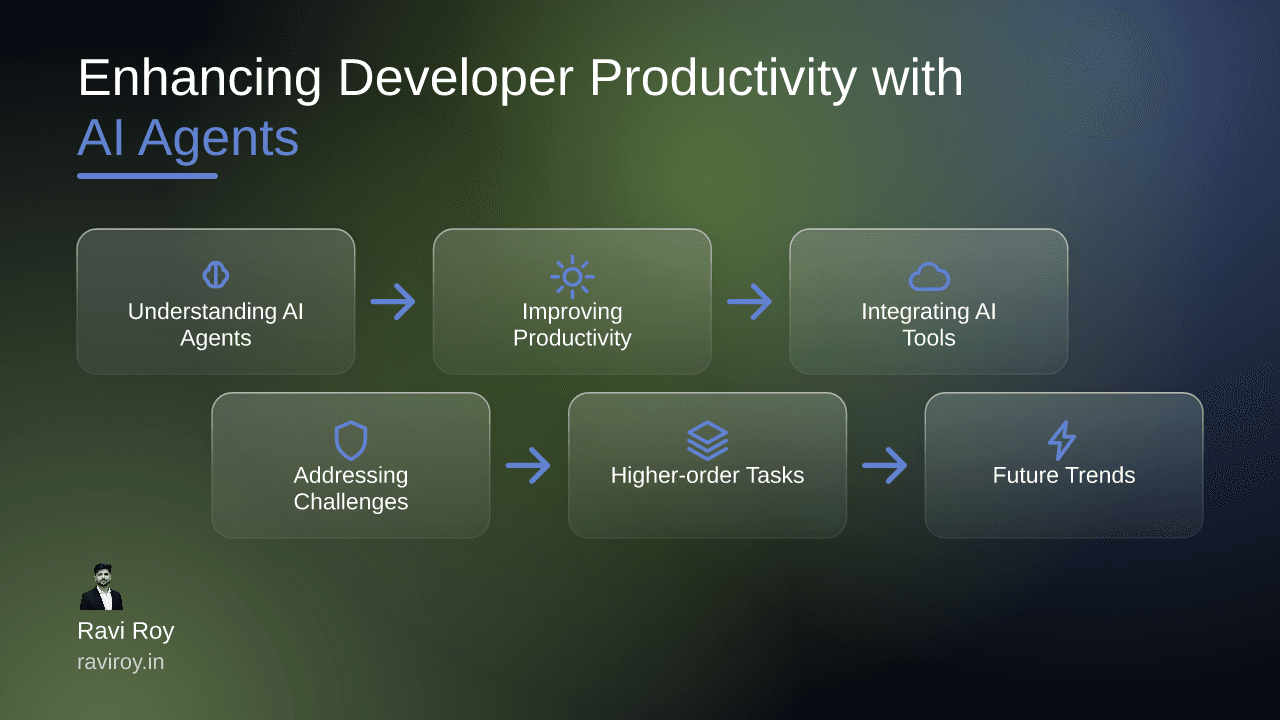
Enhancing Developer Productivity with Effective AI Agents
The world of software development is rapidly evolving, driven by the ability of AI agents to enhance productivity. Imagine having a virtual assistant that not only executes repetitive tasks but also aids in complex decision-making processes. This isn't just a dream—it's a reality that can significantly transform how developers work.
Understanding AI Agents and Their Role in Development
What Are AI Agents?
AI agents are software entities designed to perform tasks on behalf of users, utilizing algorithms and machine learning to function autonomously. Their core functionalities revolve around processing information, making decisions, and learning from interactions. By harnessing vast amounts of data, AI agents can streamline workflows, significantly enhancing developer productivity.
The Evolution of AI Agents in Software Development
The journey of AI agents in software development has been remarkable, marked by advancements in machine learning, natural language processing, and data analysis. Early implementations were rudimentary at best, but as computational power has surged, so too has the ability of AI agents to tackle more complex tasks. Today, we witness a paradigm shift towards more autonomous workflows, where AI can predict bugs, suggest code enhancements, and automate mundane tasks, allowing developers to focus on higher-level problems.
How AI Agents Improve Developer Productivity
Efficiency Gains Through Automation
Imagine an AI agent capable of automating mundane tasks like code formatting, testing, and even deployment. By handling tasks such as generating boilerplate code or managing pull requests, AI can save developers countless hours. Here are a few specific tasks that AI agents can automate:
Automated Code Generation: Tools like GitHub Copilot can suggest code snippets or entire functions based on comments.
Testing Automation: AI can run repetitive tests, flagging bugs before they escalate into major issues.
Continuous Integration/Continuous Deployment (CI/CD): AI agents can monitor application performance and automate deployment processes, ensuring seamless transitions to production.
Reducing the Cognitive Load of Developers
Developers often face cognitive overload due to constant context-switching between tasks. AI agents can alleviate this pressure by handling decision-making processes:
Contextual Assistance: AI tools can analyze the code being worked on and provide real-time recommendations, enabling focus on immediate tasks without extensive searching for solutions.
Minimized Context-Switching: By offering suggestions and handling background tasks, AI agents help maintain focus, enhancing overall productivity.
Benefits of Integrating AI Agents into Development Tools
Comprehensive Integration Across the Software Development Lifecycle
AI agents can be integrated seamlessly with tools like Git, Jira, and CI/CD systems. This integration fosters greater collaboration and workflow efficiency. A well-connected environment allows AI agents to pull relevant context from various stages in the development process, making automated suggestions even more relevant.
Real-time Code Review and Testing
Incorporating AI agents facilitates real-time code analysis and error detection. Features such as:
Instant Feedback: AI tools can analyze code as it’s written, providing suggestions and detecting errors on-the-fly.
Enhanced Collaboration: Tools like GitHub and Bitbucket enable teams to incorporate AI agents for code review, fostering collaboration and faster feedback cycles.
Case studies have shown that teams employing AI agents have improved collaboration by reducing manual review times and enhancing the overall quality of code.
Addressing Challenges and Risks Associated with AI Agents
Ethical Considerations in AI Agent Design
While AI agents offer immense advantages, ethical dilemmas must be addressed. Issues regarding the transparency of AI decision-making processes can impact trust and integration within teams. It’s crucial to ensure that developers understand how AI functions and the basis of its recommendations.
Mitigating Risks in Software Engineering
With great power comes great responsibility. Organizations can minimize risks associated with AI in software engineering by:
Conducting Thorough Testing: Ensuring the AI agents are robust and reliable before continuous deployment.
Maintaining Human Oversight: Establishing checks and balances to monitor AI decision-making helps preserve code quality and reliability.
Higher-order Tasks and Context Assembly with AI Agents
Understanding Contextual Awareness
AI agents can gather and prioritize context from various sources, significantly supporting developers in their daily tasks. They synthesize information from documentation, historical codebases, and user inputs, offering dynamic assistance that evolves with project needs.
Leveraging AI for Complex Problem Solving
Consider a scenario where AI agents manage a complex software project with numerous dependencies. By using contextual understanding, they can anticipate issues, suggest alterations, and even facilitate higher-order cognitive tasks such as architectural decisions.
Democratization of Development through AI Agents
Upskilling with AI: Making Development Accessible
AI agents play a pivotal role in lowering entry barriers for new developers. By breaking down coding tasks into manageable components and providing on-the-go assistance, these agents make the learning curve less steep. This democratization allows novices to engage with technology that may have previously appeared inaccessible.
Improving Team Collaboration
AI agents enhance collaborative coding efforts, particularly in diverse teams. They serve as a bridge for knowledge sharing and mentorship, facilitating a more inclusive environment where members can grow together.
Future Trends in AI Agents for Developer Productivity
Emerging Technologies and Their Impact
The landscape of AI is constantly changing, with emerging technologies reshaping the way we approach productivity in development. Expect trends such as stronger integration of AI with cloud-based services and further utilization of advanced machine learning techniques to automatically refactor code.
Looking Ahead: The Future of Human-AI Collaboration
While AI agents currently assist developers, the evolution of machine learning will deepen their roles in the development process. We could see AI agents taking on more strategic roles, collaborating with human developers to innovate and optimize coding practices further.
As we venture into the future, the power of AI agents promises to redefine the boundaries of productivity in software development.
What has been your experience with AI agents in your development workflow, and how have they changed your approach to coding?
💬 Join the conversation — share your take in the comments and tell us what you’d add.