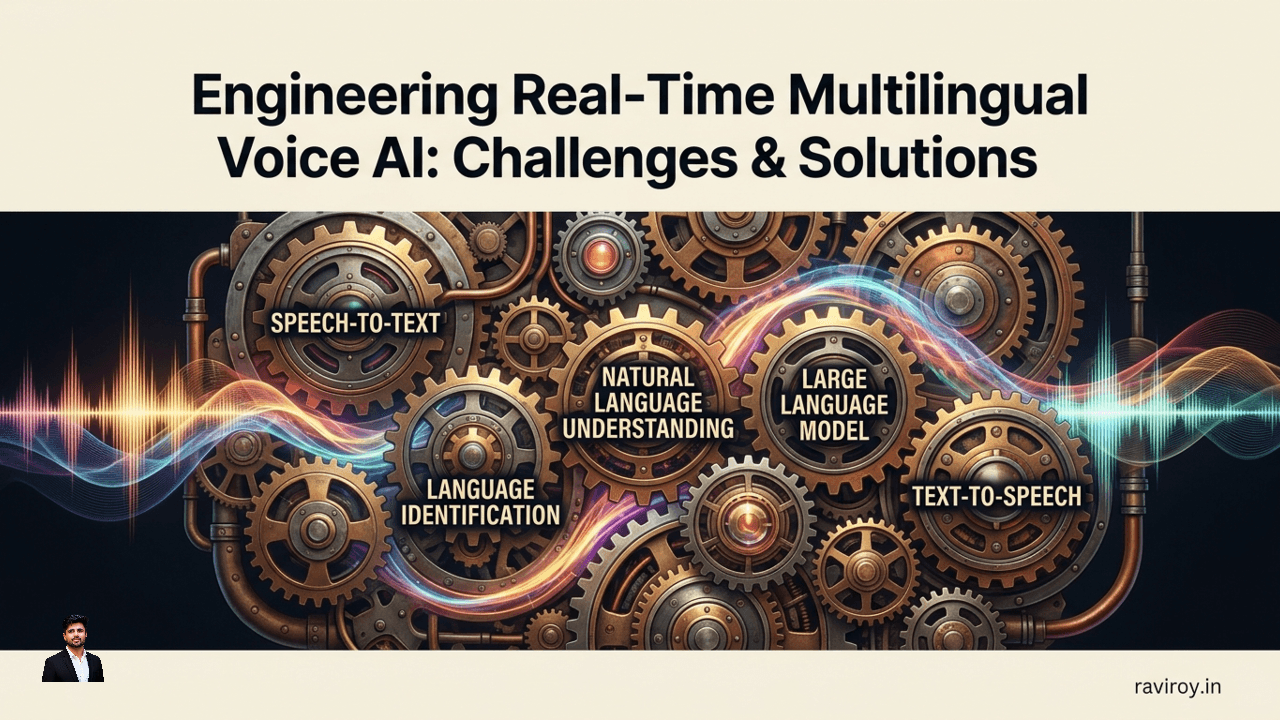
Imagine a world where language barriers simply vanish, where conversations flow effortlessly across any tongue, in real-time. This isn't science fiction; it's the ambitious frontier of engineering real-time multilingual voice AI, a domain poised to revolutionize global business, customer service, and human connection. The demand for seamless voice interactions across languages is skyrocketing, driven by multinational corporations seeking to serve diverse customer bases and by individuals desiring instant communication without linguistic friction.
"Real-time" in this context isn't just fast; it implies sub-second latency, crucial for natural, fluid turn-taking in a conversation. Any perceptible delay breaks immersion and undermines trust. A typical cascaded multilingual voice AI system comprises several interconnected components: Speech-to-Text (STT) for transcribing audio, Language Identification (Language ID) to determine the spoken language, Natural Language Understanding (NLU) to grasp intent, a Large Language Model (LLM) for sophisticated reasoning and response generation, and Text-to-Speech (TTS) to convert the AI's response back into natural-sounding audio. Building these systems to operate instantaneously across a multitude of languages presents a fascinating, yet formidable, set of engineering challenges.
Core Engineering Hurdles in Multilingual Voice AI
Developing a voice AI that can fluently converse in multiple languages without skipping a beat pushes the boundaries of current technology. The complexity escalates dramatically when real-time performance is a non-negotiable requirement.
Low-Latency Processing Demands
The core of real-time conversational AI lies in its ability to process information almost instantly. For a truly natural interaction, the entire round-trip from a user speaking to the AI responding must occur within a very tight latency budget. Here’s a breakdown of typical targets:
Speech-to-Text (ASR): < 200 milliseconds (ms)
Language Identification (LangID): < 50 ms (often integrated into ASR or run concurrently)
Natural Language Understanding (NLU): < 100 ms
Large Language Model (LLM) Inference: < 200 ms (depending on complexity and model size)
Text-to-Speech (TTS): < 200 ms
End-to-End Latency: < 500 ms for a genuinely natural conversational flow.
Achieving these numbers consistently across varying network conditions, audio qualities, and computational loads requires highly optimized models, efficient inference engines, and robust infrastructure design.
Multilingual ASR Accuracy and Coverage Trade-offs
One of the most significant challenges is maintaining high Automatic Speech Recognition (ASR) accuracy across a broad spectrum of languages. As the number of supported languages increases, there's often an inverse relationship with per-language accuracy, especially for low-resource languages. A unified multilingual ASR model might struggle to generalize effectively across vastly different phonetics, grammars, and vocabularies. Training a single massive model on data from hundreds of languages can lead to a dilution of performance for individual languages (Why does multilingual ASR accuracy drop as language coverage increases?). This can manifest as:
Reduced accuracy for niche languages: Data scarcity for less common languages means models have less exposure and thus poorer performance.
Interference between languages: Similar-sounding phonemes or words across languages can cause confusion, leading to misrecognitions.
Increased model complexity: Larger models are slower to infer and require more computational resources, directly impacting latency.
Engineers must carefully balance the desire for broad coverage with the necessity for high accuracy in target languages.
The Code-Switching Conundrum
Code-switching, the act of alternating between two or more languages within a single conversation or even a single sentence, is a common linguistic phenomenon. For real-time multilingual voice AI, it's a major hurdle. Common failure modes include:
Misinterpreting language boundaries: The system might fail to recognize the switch, continuing to process the input using the previous language model.
Defaulting to the dominant language: In mixed-language inputs, the AI might over-prioritize the statistically more frequent or 'dominant' language, incorrectly transcribing or interpreting phrases from the less dominant language.
Loss of context: If the NLU or LLM isn't designed to handle mixed-language inputs, the meaning of a code-switched utterance can be lost, leading to irrelevant or nonsensical responses.
Effectively handling code-switching requires sophisticated language identification and processing mechanisms that can adapt on the fly (How do you handle code-switching in real-time voice AI?, What causes multilingual voice AI to fail on real-world audio?).
Robustness to Accents, Dialects, and Noise
Human speech is incredibly diverse. Accents and dialects within the same language can vary significantly in pronunciation, intonation, and vocabulary. Furthermore, real-world audio is rarely pristine; it's often contaminated with background noise, echo, and varying microphone quality, especially in telephony channels. Achieving consistent performance across this spectrum of conditions is challenging:
Accent variability: An ASR model trained predominantly on standard American English might struggle with Indian English, Scottish accents, or regional dialects.
Dialectal differences: Subtle shifts in vocabulary or grammatical structures unique to a dialect can confuse NLU systems.
Noise resilience: From bustling call centers to noisy home environments, the AI must intelligently filter out irrelevant audio while preserving speech signal integrity.
Training robust models requires vast, diverse datasets covering these variations, often augmented with noise and channel simulations.
Architectures for Scalable, Low-Latency Multilingual Voice AI
Overcoming these hurdles demands thoughtful architectural choices, prioritizing speed, flexibility, and fault tolerance.
Streaming-First vs. Batch Processing
For real-time applications, streaming audio processing is paramount.
Streaming Processing: Audio is processed in small chunks (e.g., 20-50ms segments) as it arrives. This allows for:
Partial results: ASR can output partial transcriptions, enabling quicker NLU processing or feedback to the user.
Speculative decoding: Predicting future words based on partial audio, reducing overall latency.
Low latency: Critically, it avoids waiting for an entire utterance to complete before beginning processing.
Real-time feedback: Enables features like live transcription or immediate error correction.
Batch Processing: The entire audio segment is captured and then processed as a whole. While simpler to implement for non-real-time tasks, it introduces significant latency for conversational AI, as the system must wait for the user to finish speaking. This approach is unsuitable for natural, turn-based dialogue.
Architectures for real-time systems typically employ streaming pipelines, often using message queues (like Kafka or RabbitMQ) to pass audio chunks and partial results between microservices.
Decoupling Language Identification
Early and accurate language identification is critical for routing audio to the correct language-specific models and achieving low latency. Strategies include:
"Listen-First" Approach: A dedicated, lightweight language identification model runs continuously, analyzing incoming audio to detect the primary language (or languages in code-switching scenarios) before routing the full audio stream to specialized ASR models.
Continuous Language ID: Rather than a one-time detection, the language ID model continually monitors the audio stream, adapting to potential code-switches in real-time. This often involves embedding language identification directly into the ASR or using shared multilingual embeddings across models.
Heuristic-based Routing: In scenarios with a limited set of known languages, rules can be applied based on early phoneme recognition or even user profile settings, though this is less robust for truly dynamic environments (How do you route a voice AI system to the right language model automatically?).
Hybrid Edge-Cloud Deployments
Latency can be drastically reduced by performing computation closer to the user. Hybrid edge-cloud deployments leverage this principle:
Edge Processing: Running components like initial ASR or basic NLU models directly on the user's device (e.g., smartphone, smart speaker) or a local gateway server. This significantly reduces round-trip delays to cloud data centers.
Benefits: Lower latency, improved data sovereignty (data can be processed locally without leaving the device), reduced cloud infrastructure costs, offline capabilities.
Challenges: Limited computational resources on edge devices, model size constraints, complex deployment and update mechanisms, maintaining model accuracy on diverse edge hardware (There is growing interest in edge or hybrid processing to reduce round-trip delay.).
Cloud Processing: More resource-intensive tasks, such as complex LLM inference, advanced NLU, or database lookups, remain in the cloud, where scalable computational power is readily available.
A common hybrid pattern involves a lightweight ASR model running on the edge to provide rapid transcription and initial intent detection, while detailed responses are generated by cloud-based LLMs.
Synchronizing the STT-LLM-TTS Pipeline
Maintaining conversational flow and context across distinct STT, NLU, LLM, and TTS modules is paramount. This requires sophisticated orchestration and context passing mechanisms (How do STT, LLM, and TTS stay synchronized in a multilingual voice agent?).
Consider an end-to-end architecture pattern for real-time multilingual voice AI:
Audio Ingestion: Streaming audio from the client (microphone, telephony channel) is sent to an Audio Streaming Service.
Pre-processing & Language ID: The service chunks the audio and passes it to a Multilingual ASR/Language ID Service. This service outputs partial text transcripts along with confidence scores for identified languages.
NLU & LLM Orchestration: Partial transcripts and language IDs are sent to a Conversational Orchestrator. This component:
Manages conversational state and context.
Routes to the appropriate language-specific NLU models (if not fully language-agnostic).
Passes intent and entities to a Multilingual LLM Service for generating a response.
Manages turn-taking, detecting when the user has stopped speaking and when to prompt the AI's response.
Response Generation: The LLM generates a text response in the target language.
TTS: The text response is sent to a Multilingual TTS Service which generates streaming audio.
Audio Playback: The TTS audio stream is sent back to the client for playback.
Key data flows involve high-throughput message queues between services. Context (e.g., conversation history, user preferences, detected language) is explicitly passed along the pipeline to ensure coherence. An example interaction flow could be:
graph TD
    User --> Audio_Stream_Svc
    Audio_Stream_Svc --> Multilingual_ASR_LangID_Svc
    Multilingual_ASR_LangID_Svc --> Conversational_Orchestrator
    Conversational_Orchestrator --> Multilingual_NLU_Svc
    Multilingual_NLU_Svc --> Multilingual_LLM_Svc
    Multilingual_LLM_Svc --> Conversational_Orchestrator
    Conversational_Orchestrator --> Multilingual_TTS_Svc
    Multilingual_TTS_Svc --> User
This modular approach, often leveraging microservices and cloud-native technologies, allows for independent scaling and optimization of each component (What is the best architecture for low-latency multilingual voice AI?).
Advanced Language & Contextual Understanding
Beyond basic translation, true multilingual voice AI demands nuanced understanding and generation.
Mitigating Code-Switching Failures
Robust handling of code-switching is a significant area of active research. Technical approaches include:
Multilingual Language Models with Shared Embeddings: Training a single large model on vast amounts of multilingual data, where different languages share parts of the model's internal representations (embeddings). This allows the model to inherently understand relationships between languages and switch more naturally.
Language-Agnostic Feature Extraction: Designing front-end speech processing to extract features that are less tied to a specific language, making the subsequent ASR and NLU models more robust to linguistic shifts.
Dynamic Model Switching/Ensembling: Employing multiple language-specific models and dynamically switching or ensembling their outputs based on real-time language ID scores. This is more resource-intensive but can offer higher accuracy for specific languages.
Contextual Code-Switching Detection: Using machine learning models trained specifically to identify code-switching points within an utterance, informing downstream NLU and LLM components to adjust their processing strategies (How do you handle code-switching in real-time voice AI?).
Culturally Aware NLU and Generation
Moving from generic multilingual support towards culturally aware tone and intent handling is crucial for building trust and avoiding miscommunication. This involves:
Culturally-specific intent mapping: An "urgent request" might be expressed differently across cultures. NLU models need to be trained on datasets that reflect these cultural nuances.
Tonal generation: TTS models must be capable of generating speech with appropriate prosody, intonation, and emotional tone for the target culture. A direct, assertive tone acceptable in one culture might be perceived as rude in another.
Avoiding faux pas: LLMs need to be fine-tuned with cultural knowledge to avoid generating responses that are inappropriate, insensitive, or based on incorrect assumptions. This includes understanding idioms, common sayings, and social conventions.
User feedback loops: Continuously incorporating user feedback from different cultural groups to refine model behavior and generation style (Teams are moving from generic multilingual support toward culturally aware tone and intent handling.).
Handling Regional Dialects and Slang
Variations in vocabulary, pronunciation, and syntax across different regional dialects and colloquialisms within the same language pose distinct challenges. Strategies include:
Dialect-specific acoustic models: For ASR, creating or adapting acoustic models specifically for prominent dialects (e.g., different variants of Spanish, English, or Arabic).
Vocabulary expansion: Curating extensive lexicons that include regional slang and colloquialisms, which are then integrated into ASR dictionaries and NLU knowledge bases.
Domain-specific training data: Collecting and augmenting training data that specifically includes examples of regional speech patterns, slang, and common phrases.
Pronunciation variations: Incorporating multiple pronunciation variants for words into the ASR's dictionary to handle diverse regional pronunciations.
For example, when developing a voice AI for a customer service application in Brazil, it's not enough to simply use "Portuguese." The system might need to understand the nuances of Paulistano vs. Carioca accents and vocabulary to truly serve its users effectively.
Testing, Observability, and Debugging in a Multilingual Environment
The complexity of multilingual voice AI systems necessitates rigorous testing and robust observability tools.
Designing Comprehensive Multilingual Benchmarks
Creating comprehensive test datasets is foundational for evaluating and improving multilingual voice AI. This methodology should include:
Language coverage: Test sets for every supported language, ensuring proportionate representation based on usage.
Accent and dialect diversity: Include recordings from various regional accents and dialects within each language.
Noise conditions: Augment data with different levels and types of background noise (e.g., office, street, music, call center noise).
Code-switched utterances: Specifically design test cases that involve code-switching, assessing the system's ability to seamlessly transition between languages.
Domain-specific vocabulary: Ensure coverage of jargon and terminology relevant to the application's domain (e.g., medical, financial, technical terms).
Scenario-based testing: Create realistic conversational scenarios that test end-to-end performance, intent understanding, and appropriate response generation (How do you test voice AI across accents, dialects, and noisy environments?).
A robust testing framework might involve automated evaluation metrics (e.g., Word Error Rate for ASR, F1 score for NLU intents) alongside human evaluation for nuanced aspects like naturalness and cultural appropriateness.
Real-World Audio Dataset Curation and Augmentation
The adage "garbage in, garbage out" is particularly true for AI. High-quality, diverse audio data is crucial.
Collection: Actively collect real-world audio data from target locales and use cases. This can involve partnerships with call centers, field recordings, or specialized data collection agencies.
Annotation: Meticulously annotate collected data with transcriptions, language labels, accent types, speaker demographics, and noise characteristics. This is often a labor-intensive process requiring skilled linguists.
Augmentation: Generate synthetic variations of existing data by applying transformations like:
Noise injection: Adding various types of background noise at different signal-to-noise ratios.
Speaker perturbation: Modifying pitch, speed, and volume of speech.
Reverberation: Simulating different acoustic environments.
Code-switching synthesis: Artificially generating code-switched utterances from monolingual speech.
Crowdsourcing: Leverage platforms for crowdsourced data collection and annotation, ensuring quality control mechanisms are in place.
Monitoring and Debugging Complex Pipelines
Debugging a real-time multilingual voice AI system is like diagnosing a complex organism. Robust observability is essential to identify and isolate failures at different stages.
Comprehensive Logging: Implement detailed logging at every stage of the pipeline:
Input audio characteristics (e.g., volume, duration).
Raw ASR outputs and confidence scores.
Language ID predictions.
NLU intents and entities detected.
LLM inputs and outputs.
TTS generated text and audio details.
Latency metrics for each component.
Metrics & Dashboards: Utilize monitoring tools (e.g., Prometheus, Grafana) to track key performance indicators (KPIs) in real-time:
Overall system latency.
ASR Word Error Rate (WER) per language.
NLU intent accuracy.
Language ID accuracy.
Error rates for each service.
Resource utilization (CPU, GPU, memory).
Distributed Tracing: Implement distributed tracing (e.g., OpenTelemetry, Jaeger) to follow a single request's journey across multiple microservices. This is invaluable for pinpointing exactly where a request fails or experiences unacceptable latency. For instance, if a user experiences a slow response, tracing can show if the bottleneck was ASR processing, LLM inference, or a network delay.
Compliance, Data Residency, and Telephony Integration
Operationalizing multilingual voice AI globally introduces non-technical considerations that significantly impact architectural design.
Navigating Data Residency Requirements
Strict data residency laws (e.g., GDPR, CCPA, various local sovereignty laws) dictate where personal data can be stored and processed. For multilingual voice AI, this means:
Regional Processing Centers: Architecting the system to allow data to be processed within specific geographical regions, often requiring separate cloud deployments or clusters in each region.
Geo-Fencing: Implementing logic to route user requests and their associated data to the appropriate regional processing center based on their location.
Anonymization: Employing techniques to anonymize or pseudonymize sensitive user data as early as possible in the pipeline, reducing the scope of strict data residency requirements for downstream processes.
Policy-driven routing: Designing a system where data handling policies are configurable and enforced automatically based on the detected origin of the voice interaction (How do compliance and data residency affect multilingual voice AI design?).
Telephony-Specific Optimizations
Integrating with telephony channels presents unique challenges not typically found in web or mobile voice applications.
Low-Bandwidth Codecs: Telephony often uses low-bandwidth codecs (e.g., G.711, G.729), which can degrade audio quality and make ASR more challenging. Models must be specifically trained or fine-tuned on telephony audio to compensate.
Barge-in Handling: The ability for a user to interrupt the AI while it's speaking. This requires sophisticated voice activity detection (VAD) and ASR systems that can detect speech over the AI's output and gracefully interrupt the AI's response generation.
DTMF Tones: Dual-Tone Multi-Frequency (DTMF) tones (keypad presses) must be identified and filtered out or processed separately, as they are not speech.
Call Center Latency Budgets: Call centers operate under extremely tight latency budgets, where every millisecond counts, as delays directly impact agent productivity and customer satisfaction. This reinforces the need for sub-second end-to-end processing.
Security and Privacy by Design
Protecting sensitive voice data is paramount. Security and privacy must be baked into the design from the outset.
End-to-End Encryption: Encrypting voice data at rest and in transit, from the user's device to the processing servers and back.
Anonymization Techniques: Employing techniques to strip personally identifiable information (PII) from voice recordings and transcriptions, especially for data used in model training. This can involve voice anonymization, text redaction, or synthetic data generation.
Access Controls: Implementing strict role-based access controls (RBAC) to ensure only authorized personnel and services can access sensitive data or modify system configurations.
Regular Audits and Penetration Testing: Continuously auditing the system for vulnerabilities and performing penetration tests to identify and remediate security weaknesses.
The Future: Towards Unified Speech-Native Models
While cascaded pipelines offer modularity, the next frontier in real-time multilingual voice AI points towards more integrated, speech-native approaches.
End-to-End Speech-to-Speech Translation
Unified speech-to-speech (S2S) translation models represent a paradigm shift. Instead of a sequence of STT, NLU, LLM, and TTS, these models directly map input speech in one language to output speech in another language. The intermediate text representation is either entirely bypassed or used only as a latent, internal representation.
Conceptually, a single neural network takes raw audio in English as input and directly generates raw audio in Spanish as output. This contrasts sharply with the current process of "English audio -> English text -> Spanish text -> Spanish audio" (Speech-native or speech-to-speech approaches are gaining interest as alternatives to cascaded STT-LLM-TTS pipelines.).
Benefits and Trade-offs
This novel approach offers several potential advantages but comes with its own set of trade-offs:
Benefits:
Lower Latency: Eliminating multiple processing steps and intermediate representations can significantly reduce overall latency.
More Natural Prosody: The model can retain and transfer the speaker's original intonation, emotion, and speaking style more effectively, leading to more natural-sounding translated speech.
Reduced Error Propagation: Errors in one module (e.g., ASR misrecognition) don't cascade and amplify through subsequent modules.
Potentially Better Handling of Code-Switching: A truly unified model might naturally handle mixed-language input and output without explicit language identification steps.
Trade-offs:
Black Box Nature: S2S models can be more opaque, making it harder to debug specific errors or understand why a particular translation or pronunciation was generated.
High Data Requirements: Training these models requires enormous amounts of parallel speech-to-speech data, which is far scarcer than speech-to-text or text-to-text data.
Computational Intensity: These models are typically very large and computationally demanding, requiring significant processing power for training and inference.
Modularity and Explainability: The cascaded approach allows for easier updates to individual components (e.g., a new NLU model) and provides intermediate outputs (e.g., the text transcript) for logging and analysis, which is harder with end-to-end S2S.
Migration Considerations
Transitioning existing cascaded systems towards more speech-native architectures is a complex undertaking.
Data Strategy: A primary concern is the availability and creation of vast, high-quality speech-to-speech parallel corpora. This often requires innovative data collection and synthetic data generation techniques.
Model Development: Significant research and development effort is needed to build and optimize these complex end-to-end models.
Infrastructure: New inference pipelines might be required to handle the large model sizes and computational demands, potentially leveraging specialized hardware (e.g., advanced GPUs).
Hybrid Approaches: A likely initial step involves hybrid models that might still use text as an intermediate representation but integrate more tightly, or models that tackle smaller, specific S2S tasks (e.g., accent transfer) before full translation.
The journey to truly seamless, real-time multilingual voice AI is an ongoing feat of engineering. From managing sub-second latencies and wrestling with code-switching to ensuring cultural awareness and navigating strict data regulations, the challenges are as diverse as the languages we aim to bridge. Yet, the promise of effortless global communication continues to drive innovation, pushing us towards more integrated, intelligent, and human-like conversational experiences.
What specific multilingual challenge has presented the most significant engineering hurdle for your team in building real-time Voice AI, and what unique approach did you take to overcome it?
💬 Join the conversation — share your take in the comments and tell us what you’d add.