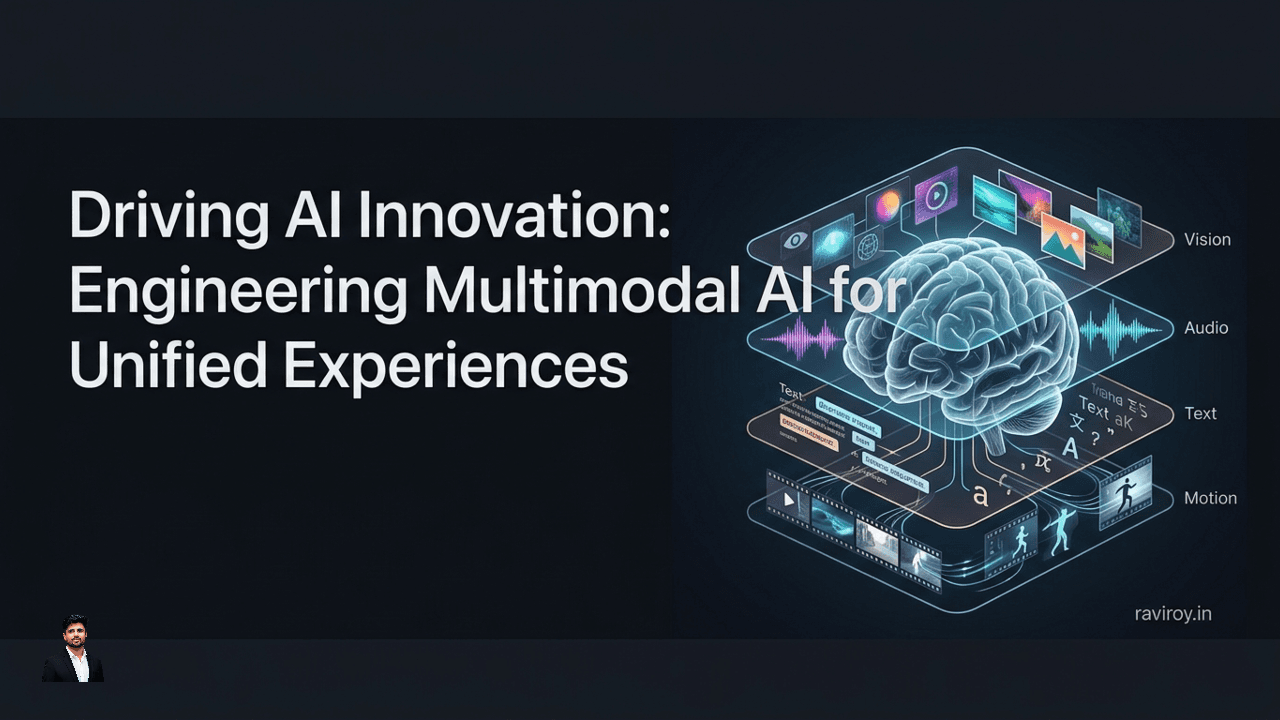
The future of AI isn't just about processing data; it's about understanding the world as humans do – through a rich tapestry of senses and information types. This revolutionary shift is being powered by multimodal AI, driving innovation by unifying disparate data streams into cohesive, intelligent systems that can perceive, reason, and interact with unprecedented depth. For engineers and developers, the imperative now is to move beyond single-modality solutions and engineer these sophisticated systems for real-world impact and unified experiences.
Driving AI Innovation: The Rise of Multimodal AI
Multimodal AI represents a significant leap forward in artificial intelligence, moving beyond systems that specialize in a single data type to create models capable of processing and relating information from multiple input modalities simultaneously. Imagine an AI system that doesn't just "see" an image, but also "hears" the accompanying audio, "reads" the descriptive text, and "understands" the context provided by video – just as a human would. This integration of data from sources like text, image, audio, and video enables a far richer understanding of information and more natural, intuitive interactions.
The transformative potential of multimodal AI is immense, paving the way for truly unified, human-like experiences across various domains. Consider intelligent assistants that can process both your spoken words and interpret your gestures, or autonomous vehicles that fuse lidar, radar, camera feeds, and real-time traffic data for superior environmental comprehension. In healthcare, multimodal diagnostic tools can combine patient reports, medical images, and genetic data to offer more accurate and personalized insights. By moving beyond the limitations of single-modality AI, we unlock capabilities that were once confined to science fiction, positioning multimodal AI as a pivotal area for current and future AI innovation.
Bridging Modalities: Core Engineering Challenges in Production
Bringing multimodal AI from research labs to robust production environments introduces a unique set of engineering challenges. The inherent diversity of data types demands sophisticated solutions at every stage of the development lifecycle.
Data Representation and Normalization Across Modalities
The fundamental challenge lies in representing diverse data types – from pixels in an image, waveforms in audio, to tokens in text – in a common, semantically meaningful space that an AI model can effectively process. Pixels carry spatial information, waveforms temporal, and text symbolic. Each has its own distribution, dimensionality, and noise characteristics.
Engineering solutions often involve:
Feature Extraction: Using modality-specific encoders (e.g., Convolutional Neural Networks for images, Transformers for text and audio sequences) to transform raw data into high-dimensional feature vectors.
Embedding Spaces: Projecting these feature vectors into a shared embedding space where distances and relationships between different modalities can be learned and compared. This ensures that, for instance, the embedding of an image of a cat is "close" to the embedding of the word "cat" in that shared space.
Normalization: Applying normalization techniques (e.g., batch normalization, layer normalization, or specialized techniques like z-score normalization) to feature vectors from different modalities. This is critical to prevent one modality's large feature magnitudes or distributions from dominating the learning process, ensuring equitable contribution from all inputs.
The Intricacies of Multimodal Data Alignment and Fusion
Once data is represented, the next hurdle is to align and fuse information that originates from different sources, potentially at different rates or with different temporal/spatial characteristics. Consider a video depicting someone speaking: aligning the audio waveform with the corresponding lip movements in the video frames is a non-trivial task that requires precise temporal synchronization. Similarly, associating an image with its natural language caption requires semantic alignment.
Different data fusion strategies exist, each with its own trade-offs:
Early Fusion: Concatenating raw data or low-level features from different modalities before feeding them into a single model. This approach can capture fine-grained interactions but is highly sensitive to alignment issues and often requires a very large, complex model.
Late Fusion: Processing each modality independently with its own specialized model, then fusing their high-level outputs (e.g., classification probabilities or embeddings) at the final decision stage. This offers modularity and fault tolerance but might miss crucial early interactions between modalities.
Intermediate Fusion: The most common and often effective approach. Modality-specific encoders extract features, which are then fused at an intermediate layer of a larger multimodal model. This allows for rich interaction while retaining some modularity. Techniques like cross-attention mechanisms (e.g., in Transformers) are particularly powerful here, allowing different modalities to "attend" to relevant parts of each other's representations.
Real-time data processing integration is a significant engineering challenge. Asynchronous data streams, varying latency requirements for different modalities, and the computational intensity of fusion models demand highly optimized pipelines and robust orchestration frameworks.
Robustness in the Face of Missing or Noisy Data
Production systems must operate reliably even when one or more modalities are unavailable or corrupted. For example, a voice assistant might encounter poor audio quality, or an autonomous vehicle's camera might be obscured. A truly robust multimodal AI system should degrade gracefully rather than failing entirely.
Strategies for handling missing or noisy data include:
Modality Dropout: During training, randomly dropping entire modalities to force the model to learn robust representations from partial inputs.
Imputation Techniques: For missing data, inferring values based on available modalities or using placeholders that the model learns to ignore.
Attention Mechanisms: Designing models where attention weights can dynamically emphasize available, high-quality modalities and de-emphasize noisy or missing ones.
Redundancy and Sensor Fusion: Leveraging inherent redundancy in multiple sensors (e.g., both vision and radar for object detection) to provide complementary information.
A common limitation in complex multimodal applications is interpretability. Understanding why a model made a specific decision when considering multiple, interwoven data streams can be profoundly difficult, presenting a hurdle for debugging, auditing, and building user trust.
Architecting Unified Experiences: Practical Development Strategies
Building effective multimodal AI systems requires careful architectural design, from data pipelines to model selection and training.
Foundational Data Pipeline Design
A robust data pipeline is the backbone of any production-grade multimodal system. It must be designed to handle heterogeneous data sources, varying data rates, and different preprocessing requirements.
A typical pipeline might involve:
Ingestion: Collecting raw data from diverse sources (e.g., video streams, audio recordings, text logs) often in real-time. Tools like Apache Kafka or Google Cloud Pub/Sub are excellent for scalable ingestion.
Preprocessing:
Modality-Specific Cleaning: Noise reduction for audio, OCR for text in images, tokenization for text.
Synchronization: Aligning temporal data streams (e.g., audio and video) using timestamps or visual cues.
Resampling/Rescaling: Standardizing data formats, resolutions, and sampling rates across modalities.
Annotation/Labeling: Curating high-quality multimodal datasets, which is often the most labor-intensive part.
Storage: Storing processed data in suitable formats (e.g., TFRecords, Parquet, or specialized multimodal databases) that facilitate efficient retrieval for training.
# Conceptual Python snippet for a multimodal data pipeline stage
def preprocess_multimodal_data(text_data, audio_data, video_data):
    # Text preprocessing
    cleaned_text = text_tokenization_and_normalization(text_data)

    # Audio preprocessing
    resampled_audio = resample_audio(audio_data, target_sr=16000)
    audio_features = extract_mfccs(resampled_audio)

    # Video preprocessing
    frame_sequence = extract_frames(video_data, frame_rate=10)
    resized_frames = resize_frames(frame_sequence, target_size=(224, 224))

    # Synchronization (simplified: assumes alignment based on timestamps or first frame)
    # In a real system, this would involve more sophisticated temporal alignment logic.

    return cleaned_text, audio_features, resized_frames
Effective Feature Extraction and Embedding
The quality of feature extraction directly impacts the multimodal model's performance. Leveraging robust, pre-trained feature extractors is often a critical first step.
Vision: Pre-trained Convolutional Neural Networks (CNNs) like ResNet, EfficientNet, or Vision Transformers (ViT) are excellent for extracting rich visual features from images and video frames.
Text: Transformer-based models such as BERT, RoBERTa, or T5 are highly effective for generating contextualized embeddings from textual data.
Audio: Models like Wav2Vec 2.0 or various audio Transformers can extract powerful representations from speech and environmental sounds.
The goal is to project these modality-specific features into a shared embedding space. This can be achieved through:
Shared Linear Layers: After initial modality-specific encoders, pass the features through common linear layers to project them into a unified dimension.
Attention Mechanisms: Cross-attention layers are particularly effective, allowing tokens from one modality (e.g., visual features) to attend to and integrate information from another (e.g., text embeddings) and vice versa, creating a truly fused representation.
Selecting and Training Multimodal Models
The choice of multimodal model architecture depends heavily on the task and the desired level of interaction between modalities.
Cross-Attention Transformers: These architectures, exemplified by models like ViLT (Vision-and-Language Transformer) or various image-text matching models, are highly effective for tasks requiring deep interaction between modalities. They process concatenated tokens (e.g., visual tokens from an image and word tokens from text) and use self-attention and cross-attention blocks to build a joint representation.
Multi-Head Attention: A component within Transformer architectures that allows the model to simultaneously focus on different parts of the input features, extracting diverse relational information from combined modalities.
Leveraging advanced multimodal models like OpenAI's GPT-4 (which can process image and text inputs) or Google Gemini as foundational components can significantly accelerate development. These models are pre-trained on vast datasets, learning powerful cross-modal representations. For specific tasks, these foundational models can be:
Fine-tuned: Adapting the pre-trained model to a downstream task with a smaller, task-specific multimodal dataset. This is a powerful form of transfer learning.
Used as Feature Extractors: Freezing the pre-trained weights and using the model's intermediate layers to generate embeddings, which are then fed into a simpler downstream classifier or regressor.
Operationalizing Multimodal AI: Deployment & Scalability
Deploying multimodal AI systems effectively in production requires careful consideration of performance, monitoring, and ethical implications.
Optimizing for Real-time Performance
Multimodal models are often computationally intensive due to the multiple encoders and complex fusion mechanisms. Achieving real-time performance, especially for latency-sensitive applications like autonomous driving or live assistants, is paramount.
Model Compression: Techniques like quantization (reducing precision of weights), pruning (removing redundant connections), and knowledge distillation (training a smaller "student" model to mimic a larger "teacher" model) can drastically reduce model size and inference time without significant performance loss.
Hardware Acceleration: Deploying models on specialized hardware like GPUs, TPUs, or even dedicated AI accelerators (ASICs) designed for neural network operations can provide massive speedups. Edge AI deployments require further optimization for constrained environments.
Batching and Parallelization: Optimizing inference pipelines to process multiple requests concurrently or splitting large models across multiple devices.
Robust Monitoring and Evaluation
Monitoring production multimodal AI systems is more complex than for single-modality systems. It's not enough to just track model accuracy; you need to understand how each modality contributes and if data integrity is maintained.
Input Data Drift: Monitoring the distribution and quality of incoming data for each modality independently. A sudden change in audio quality or lighting conditions can signal performance degradation.
Output Consistency: Tracking the model's predictions across modalities for consistency. For example, if a model's visual component identifies a "dog" but its audio component reports "cat meows," there's an inconsistency.
Modality-Specific Metrics: Utilizing appropriate evaluation metrics for each modality (e.g., WER for speech, BLEU/ROUGE for text generation, mAP for object detection in vision) and then devising higher-level multimodal metrics that combine these.
Lack of Comprehensive Benchmarking: A current gap in the multimodal AI field is the absence of universally accepted, comprehensive benchmarking datasets and metrics that span all aspects of multimodal understanding and generation. For now, engineers often rely on custom benchmarks tailored to their specific applications, involving qualitative human evaluations alongside quantitative metrics.
Ensuring Ethical AI and Interpretability
The increased complexity of multimodal systems makes ethical considerations even more critical.
Bias and Fairness: Multimodal datasets can inherit and amplify biases present in their constituent modalities. For example, a visual dataset might disproportionately feature certain demographics, or an audio dataset might have accents that lead to performance disparities. Engineers must actively audit datasets and model outputs for unfair biases across different groups or input types.
Interpretability: Understanding why a multimodal model makes a decision is crucial for trust and debugging. Techniques like attention visualization (showing which parts of which modalities the model "focused" on) or saliency maps (highlighting important pixels/words) can offer insights. Developing methods to attribute model decisions back to specific multimodal inputs is an active research area.
Advanced Techniques for Enhanced Multimodal AI
As the field matures, advanced techniques are emerging to push the boundaries of what multimodal AI can achieve, particularly in adaptability and generation.
Continual Learning and Adaptation
Multimodal systems deployed in dynamic environments need to adapt to new data distributions, evolving user behaviors, or new types of content without forgetting previously learned knowledge (catastrophic forgetting).
Online Learning: Updating model parameters incrementally as new data arrives, often with techniques like regularization to protect critical past knowledge.
Memory Networks: Storing and retrieving past experiences or prototypes to aid in learning new tasks while preventing forgetting.
Task-Adaptive Modality Fusion: Dynamically adjusting the weighting or contribution of different modalities based on the current task or context, allowing the system to prioritize relevant information.
Semantic Alignment and Cross-Modal Generation
Leveraging generative AI, multimodal systems can not only understand but also create new content, bridging the gaps between modalities.
Cross-Modal Generation:
Text-to-Image/Video Generation: Generating realistic images or video clips from textual descriptions (e.g., Stable Diffusion, DALL-E).
Image-to-Text Description: Automatically generating captions or detailed descriptions for images or video segments.
Speech Synthesis from Text and Visual Cues: Creating highly natural-sounding speech, potentially with emotional nuances, from text input, sometimes also influenced by visual context.
Self-supervised and Weakly Supervised Learning: Overcoming the immense challenge of creating large, perfectly labeled multimodal datasets. Self-supervised methods learn representations by predicting missing parts of data or relationships within and across modalities (e.g., predicting the next frame in a video given previous frames, or aligning image patches with text descriptions without explicit labels). Weakly supervised learning uses noisy or indirect labels to learn.
The Future of Unified Experiences: Impact and Evolution
The ongoing development and operationalization of production-grade multimodal AI promise a transformative impact across nearly every industry. In healthcare, it will lead to more precise diagnoses and personalized treatment plans by integrating patient scans, clinical notes, and genomic data. In the automotive sector, multimodal AI is foundational for truly autonomous driving, enabling vehicles to perceive and react to complex, dynamic environments. Customer service will evolve with intelligent agents that understand not just what you say, but also your tone of voice, facial expressions, and even the context of your browsing history, leading to significantly more empathetic and efficient interactions.
The multimodal AI market is experiencing rapid expansion, driven by advances in deep learning architectures, the availability of vast datasets, and increasing computational power. As we move forward, we can anticipate more seamless human-computer interaction, where AI systems understand and respond to us with an almost human-like intuition, context, and nuance. This evolution will lead to highly contextual understanding, where AI doesn't just process individual data points but grasps the interconnected narrative of our digital and physical lives.
However, the journey continues. There remains an ongoing and critical need for sustained research into improving the interpretability and robustness of these complex systems, ensuring they are not only powerful but also transparent and reliable. Furthermore, prioritizing ethical development – addressing biases, ensuring fairness, and upholding privacy – will be paramount as multimodal AI becomes ever more integrated into the fabric of our society. The engineers who navigate these challenges will be at the forefront of shaping a future where AI truly mirrors and enhances human experience.
What specific challenge have you encountered when integrating different modalities (e.g., vision, voice, text) into a single AI system, and how did you approach solving it?
💬 Join the conversation — share your take in the comments and tell us what you’d add.