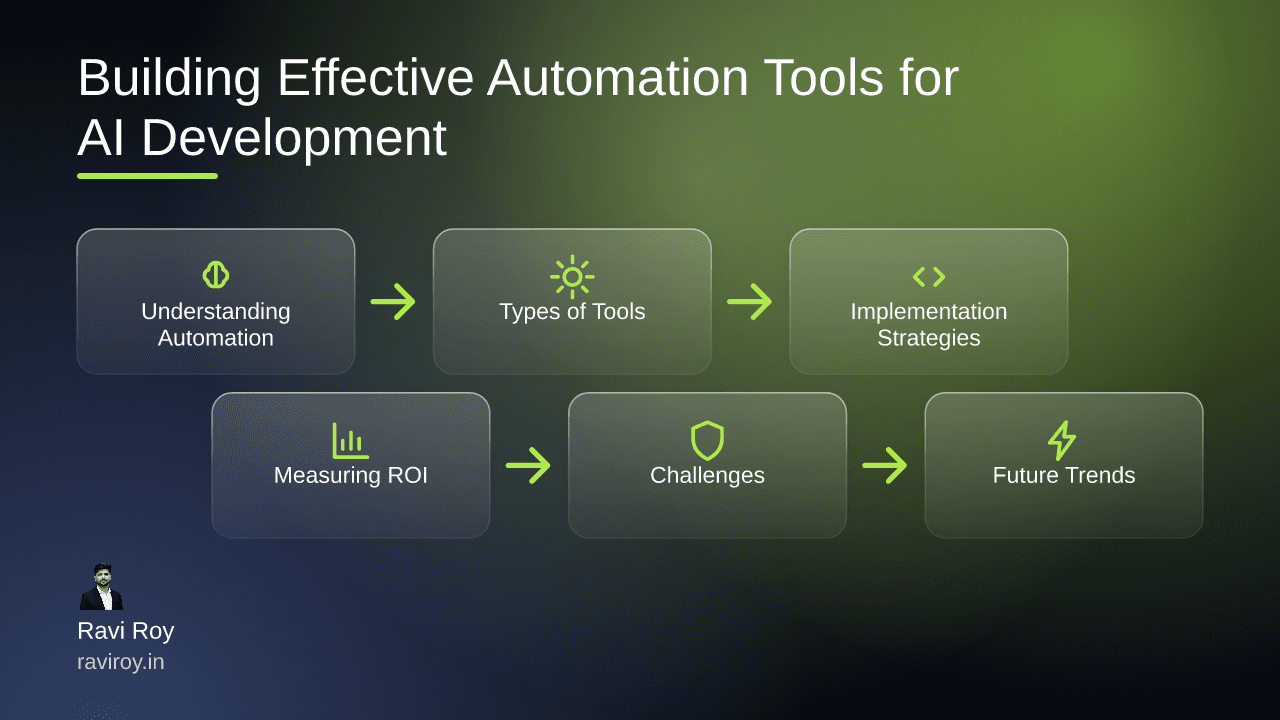
Understanding Automation in AI Development
Automation in AI development empowers organizations to streamline workflows, reduce human error, and accelerate deployment timelines. But what exactly is automation in this context? It's the use of technology to complete tasks or processes with minimal human intervention, enabling teams to focus on more strategic initiatives.
What is Automation in AI?
At its core, automation in AI involves the use of software tools to perform repetitive tasks that were traditionally done manually. This can include everything from data preprocessing to model training and deployment. The core idea is to create a more efficient and effective development environment, where AI systems can be trained and improved at scale.
Key Benefits of Automation
The implementation of automation tools in AI development comes with numerous advantages:
Increased Efficiency: Automation can drastically reduce the time needed to complete tasks, particularly those that are repetitive and time-consuming. For instance, automating data labeling enables faster dataset preparation, leading to quicker model development.
Reduced Human Error: Automating tasks reduces the risk of mistakes often caused by human oversight. This ensures higher quality outputs, particularly in tasks that require precision, like data analysis.
Faster Deployment: With automation, AI models can be rolled out more swiftly into production environments. Automated pipelines ensure that codes are deployed consistently and without delays.
Types of Automation Tools for AI
The landscape of automation tools for AI is diverse, designed to cater to various aspects of the development process. Here are three prominent types:
Low-Code and No-Code Platforms
Low-code and no-code platforms empower non-technical users to create applications with minimal coding. These platforms often feature drag-and-drop interfaces and pre-built components that speed up the application development process. This democratizes AI development, allowing more team members to contribute without deep technical knowledge.
For instance, a marketing manager might use a no-code platform to set up customer segmentation models based on sales data, leveraging AI without needing extensive programming skills.
AI-Driven Pipelines
AI-driven pipelines, or hyper-automation, integrate multiple automation processes into a single coherent system. These pipelines ensure that every step of the AI model lifecycle—from data collection to deployment—is automated. This integration enhances collaboration among teams and ensures that tasks happen seamlessly, reducing bottlenecks.
For example, an AI-driven pipeline could automate the journey from data ingestion, through model training and evaluation, right through to deployment, making AI workflows more resilient and scalable.
Cloud-Native Solutions
Cloud-native solutions are crucial in achieving scalable automation. By hosting AI tools in the cloud, organizations can leverage powerful computing resources and elastic scalability. These solutions also enable collaboration across geographically dispersed teams, ensuring that everyone has access to the latest tools and infrastructure.
In practice, consider a company that uses a cloud-native AI platform to manage its model training; this approach allows data scientists to continuously update and improve their algorithms without the constraints of local hardware limitations.
Implementation Strategies for Automation Tools
Implementing automation tools requires thoughtful planning and strategic execution. Here are critical steps for a successful rollout:
Assessing Business Readiness for AI Automation
Before diving into automation, it's vital to assess your organization's readiness. This involves conducting a thorough business analysis and engaging stakeholders across all levels. Identify areas ripe for automation by evaluating existing workflows and pinpointing inefficiencies that could be alleviated through automation.
One effective method is to conduct a survey among team members to identify pain points in current processes, fostering open dialogue about potential automation opportunities.
Developing an Automation Roadmap
Creating a comprehensive automation roadmap outlines your strategic directions. Start by mapping out your current workflows and identifying automation points that can provide significant ROI. Prioritize initiatives based on impact and feasibility, then establish clear timelines and milestones for implementation.
For example, if reducing data processing time is a priority, your roadmap may include automating data ingestion and transformation processes first, followed by model training stages.
Integration with Existing Systems
Integrating automation tools with existing systems poses challenges, but effective strategies can ease the transition. Evaluate current systems' compatibility with new automation tools and explore options for integration.
Utilizing APIs can often bridge the gap between traditional systems and modern automation solutions. A well-documented API allows for fluid data transfer and interaction between legacy systems and new cloud-based solutions.
Measuring ROI and Performance of AI Automation
Successfully demonstrating the value of automation requires clear metrics and methodologies.
Key Performance Indicators (KPIs)
Establish KPIs relevant to your automation projects. Common metrics might include:
Time Saved on Tasks: Measure the number of hours saved through automation.
Error Rates: Track changes in output quality before and after automation.
Deployment Speed: Measure the time taken to deploy models to production.
These KPIs will provide concrete evidence of improvements attributable to automation efforts.
Cost-Benefit Analysis
To effectively assess ROI, conduct a detailed cost-benefit analysis. This analysis should consider both direct costs of implementing automation (tool subscriptions, training, etc.) and indirect costs (time spent in transition, potential downtime).
Create a clear comparison between projected costs and expected savings or increased revenue resulting from improved efficiency.
Continuous Improvement Through Data Extraction
Automation should not be a "set it and forget it" solution. Use continuous data extraction to refine and enhance automated processes. Monitoring how automation affects performance through real-time analytics allows organizations to adapt quickly and improve efficiencies on-the-fly.
Challenges and Considerations in AI Automation
While automation holds great promise, there are challenges to consider:
Hidden Costs of Automation
Often, organizations overlook hidden costs associated with automation, such as training staff to use new tools or the time spent troubleshooting issues. It's essential to account for these factors during the planning phase to avoid budget overruns.
Data Security and Compliance
As automation increases, so too do concerns over data security and compliance. Implement robust security measures to safeguard sensitive data from breaches, including encryption and strict access controls. Additionally, ensure that your automation practices adhere to relevant regulations, such as GDPR or HIPAA, when applicable.
Impact on Workforce Dynamics
Automation inevitably changes workforce dynamics. It's crucial to analyze how roles may shift with the introduction of automation and what this means for team members. Offer training and reskilling opportunities to help staff transition smoothly into new roles that require oversight of automated systems rather than manual execution.
Future Trends in AI Automation
The future of AI automation promises to be exciting and transformative, paving the way for even greater efficiency and innovation.
The Role of AIOps and DevSecOps
AIOps, combining AI with IT operations, helps streamline processes and improve decision-making through data insights. Similarly, DevSecOps integrates security practices at all stages of development, ensuring that automated processes are secure from the ground up.
Emerging Technologies in Automation
The convergence of emerging technologies such as machine learning and advanced robotics will further enhance automation capabilities. Hyper-automation—automating not just tasks but entire workflows—will likely become the norm, allowing organizations to operate with unprecedented agility.
Accessibility Through Increased Automation
As automation tools continue to evolve, accessibility will significantly improve, allowing smaller businesses to harness AI technology. This democratization of technology will lead to widespread adoption and innovation across industries, leveling the playing field.
By embracing automation in AI development today, businesses can position themselves for success in an increasingly competitive landscape. What challenges have you faced while implementing automation in your AI projects? Share your experiences below!
💬 Join the conversation — share your take in the comments and tell us what you’d add.