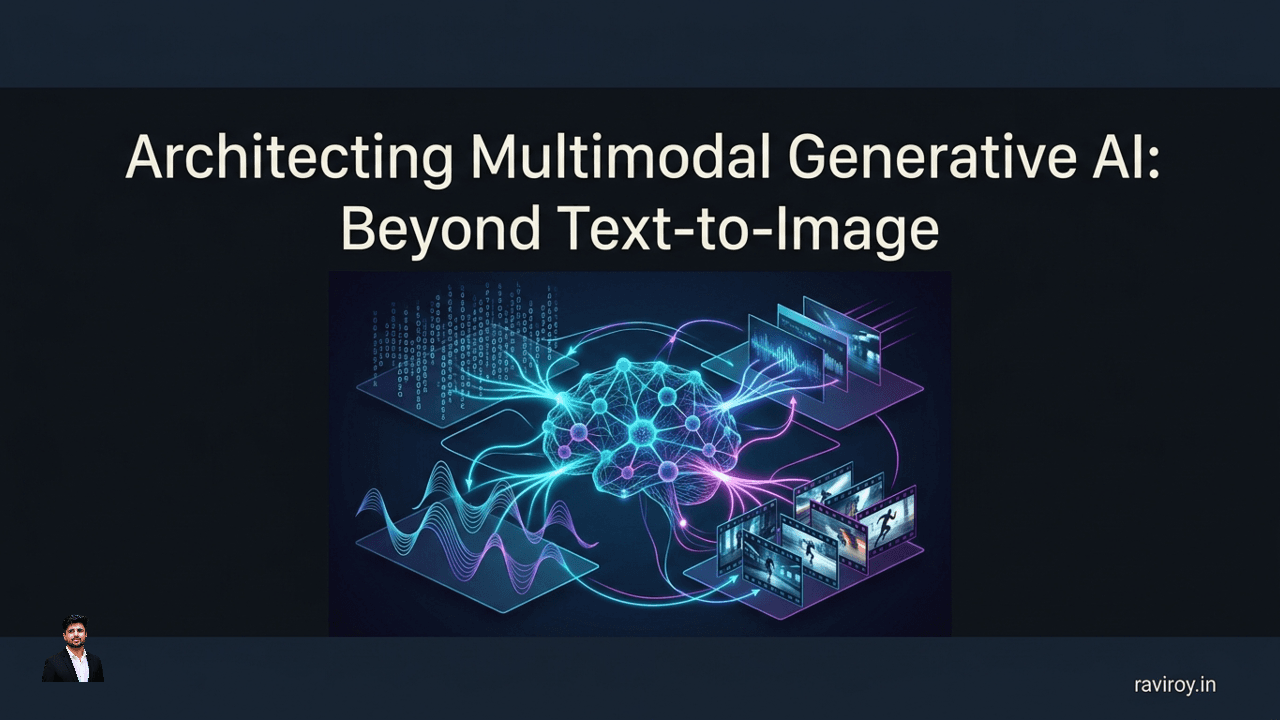
The frontier of artificial intelligence is no longer confined to processing a single type of information. We're entering an era where AI doesn't just see or hear or read, but comprehends the world through a symphony of senses, a shift that is fundamentally changing how we architect multimodal generative AI. This evolution moves us far beyond the now-familiar text-to-image capabilities, unlocking a universe of possibilities for creation and interaction.
What is Multimodal Generative AI?
At its heart, the concept of multimodal generative AI hinges on combining two powerful ideas: the ability to understand and process information from multiple types of data, and the capacity to create novel content.
Defining Multimodality in AI
Imagine trying to understand a conversation by only listening to the words, without seeing the speaker's facial expressions or body language. You'd miss crucial context. Similarly, unimodal AI systems, designed to process only one data type—be it text, images, audio, or video—often operate with inherent limitations. For instance, a text-only sentiment analyzer might struggle with sarcasm expressed through tone, or an image classifier might misinterpret an object without its textual label.
Multimodal AI transcends these limitations by processing, interpreting, and interrelating information from multiple modalities simultaneously. This means an AI can understand a complex scene by analyzing an image, reading its accompanying caption, and even listening to related audio. This holistic approach allows for a richer, more nuanced understanding of the world.
Generative AI: Creation, Not Just Classification
While discriminative AI models excel at classification (e.g., "Is this a cat or a dog?"), prediction (e.g., "What's the stock price tomorrow?"), or recognition, generative AI takes a bold step further. It's about creation. Generative models are trained on vast datasets and learn the underlying patterns and structures of that data, enabling them to produce entirely new, original content that resembles the training data. This includes generating coherent text, realistic images, compelling audio, complex code, or even full-fledged video sequences. The magic lies in their ability to synthesize, not just analyze.
The Synergy: Beyond Text-to-Image
The true power emerges when multimodality meets generativity. The early wave of text-to-image models (like DALL-E or Midjourney) captivated the world by demonstrating an AI's ability to translate textual prompts into vivid visual art. However, this was merely the tip of the iceberg. Multimodal generative AI combines the processing of diverse inputs with the creation of diverse outputs, often simultaneously.
Instead of just generating an image from text, these systems can generate video from text and audio, or craft a personalized story complete with narrated audio, visual scenes, and character dialogue, all from a high-level prompt. The foundation for this leap are Multimodal Foundation Models (MFMs), large pre-trained models capable of understanding and generating across modalities. They represent a significant shift, enabling AI to reason and produce content in a way that better mimics human cognition, understanding how different sensory inputs relate and influence each other.
How Multimodal Generative AI Works
Architecting these sophisticated systems requires a thoughtful approach to integrating disparate data types and managing immense computational demands.
Data Fusion Strategies
The core challenge in multimodal AI is effectively combining information from different modalities. Several strategies have emerged:
Early Fusion: This involves concatenating or combining features from different modalities at the input level, often by mapping them into a shared embedding space. For example, text embeddings and image embeddings could be flattened and combined before being fed into a unified model. This approach assumes a high degree of correlation between modalities from the outset.
Late Fusion: Here, each modality is processed independently by its own dedicated model (e.g., a vision model for images, a language model for text). The outputs or decisions from these separate models are then merged at a later stage, often through a voting mechanism or a meta-classifier. This is simpler to implement but might miss subtle inter-modal relationships.
Cross-Attention Fusion: This is the most prevalent and powerful strategy in modern MFMs. Inspired by the success of transformer architectures, cross-attention mechanisms allow different modalities to "attend" to each other dynamically. For instance, an image encoder might generate visual tokens, and a text encoder might generate textual tokens. A cross-attention layer then allows the text tokens to query the image tokens, seeking relevant visual information, and vice-versa, creating a rich, integrated representation.
Core Architectural Components
Multimodal generative AI systems are typically composed of several key modules:
Modality-Specific Encoders: These are specialized neural networks designed to process and extract meaningful features from individual data types.
Text Encoder: Often a transformer-based model (like BERT or GPT variants) that converts text into dense numerical embeddings.
Image/Video Encoder: Vision transformers (ViTs) or convolutional neural networks (CNNs) that extract visual features from images or video frames.
Audio Encoder: Recurrent neural networks (RNNs) or transformers that process raw audio waveforms or spectrograms.
Fusion Layers: These are where the magic of multimodal understanding happens. Cross-attention mechanisms are commonly employed. For example, in a text-to-image model, text embeddings might serve as queries, attending to key-value pairs derived from visual embeddings, allowing the model to learn how to associate descriptive words with visual features.
Generative Decoders: Once a fused, multimodal representation is formed, a generative decoder takes over to produce the desired output.
Autoregressive Models: These generate content sequentially, token by token (e.g., generating text, or pixel-by-pixel for images).
Diffusion Models: These work by iteratively denoising a random noise signal conditioned on the multimodal representation, gradually revealing the desired image, video, or audio output. They have become incredibly popular for their high-quality generative capabilities.
Addressing Computational Efficiency
The sheer scale of data and models in multimodal generative AI presents significant computational challenges.
Large Model Sizes and Data Requirements: Training MFMs can involve billions of parameters and terabytes of multimodal data, requiring extensive computing resources.
Specialized Hardware: The demanding parallel computations often necessitate powerful GPUs (Graphics Processing Units) and TPUs (Tensor Processing Units), sometimes deployed in massive clusters.
Efficient Distributed Training: Techniques like data parallelism and model parallelism are critical for distributing the training workload across multiple devices and machines, ensuring that models can be trained within reasonable timeframes.
Optimization Techniques: To make these models more practical for deployment and to reduce inference costs:
Sparse Attention: Instead of computing attention between every pair of tokens, sparse attention mechanisms compute attention only for a subset of tokens, significantly reducing computation (e.g., Longformer, Reformer).
Quantization: Reducing the precision of model weights (e.g., from 32-bit floating point to 8-bit integers) can drastically cut down memory usage and speed up inference with minimal accuracy loss.
Model Distillation: A smaller, "student" model is trained to mimic the behavior of a larger, more complex "teacher" model, resulting in a more compact and faster model with comparable performance.
Real-World Applications of Multimodal Generative AI
The impact of multimodal generative AI is beginning to ripple across industries, powering innovations that were once considered science fiction.
Enhanced Content Creation & Editing
Text-to-Video Generation: Imagine typing a script like "A golden retriever playing fetch in a sun-drenched park, slow motion" and having an AI generate a high-quality video clip. Companies are already developing models capable of this, revolutionizing filmmaking, advertising, and social media content creation.
Interactive Storyboarding: Designers can now generate dynamic assets (characters, backgrounds, props) directly from textual prompts within an interactive environment. A prompt like "Generate a grumpy wizard with a glowing staff in a magical forest" could instantly produce a usable character asset and a matching backdrop, allowing for rapid iteration and visualization in animation or game development.
Personalized Marketing Content: Based on a user's demographic data, past purchase history, and even inferred emotional state, AI can generate highly personalized ad creatives, product descriptions, or social media posts—combining bespoke imagery, tailored text, and fitting audio overlays to maximize engagement.
Building Interactive AI Systems
AI Assistants with Multimodal Understanding: Beyond simple voice commands, next-gen AI assistants can understand spoken requests, interpret visual cues (like a gesture pointing to an object on screen), and respond with a combination of generated speech, on-screen text, or even by displaying relevant images or videos. For instance, "Show me how to fix this" while pointing at a leaky faucet could trigger a step-by-step video tutorial.
Robotics and Autonomous Systems: Robots equipped with multimodal generative capabilities can interpret a rich tapestry of sensor data—camera feeds for vision, lidar for depth, microphones for sound, and haptic sensors for touch. They can then generate appropriate actions, such as navigating complex environments, manipulating delicate objects, or responding to human commands, all while adapting to unforeseen circumstances.
Educational Tools: Multimodal AI can revolutionize learning by adapting content to individual learning styles. An AI tutor might generate visual explanations for a visual learner, provide audio summaries for an auditory learner, or create interactive simulations for a kinesthetic learner, all from the same core curriculum content.
Advanced Data Analysis & Insights
Medical Image Analysis and Diagnosis: Multimodal AI can combine high-resolution medical images (MRI, X-ray) with structured patient records (demographics, symptoms, medical history), genomic data (DNA sequences), and even doctor's notes (unstructured text). This integrated analysis can lead to more accurate diagnoses, personalized treatment plans, and accelerated drug discovery by identifying subtle patterns across diverse data types.
Financial Market Prediction: Predictive models can now go beyond historical stock charts. They can incorporate real-time news articles, analyze social media sentiment trends (text and emojis), and interpret analyst reports, fusing these diverse inputs to generate more robust forecasts for market movements and investment strategies.
Architecting for Advanced Multimodal Systems
Moving beyond foundational capabilities, the next wave of multimodal AI is focused on grounding, agency, and adaptive fusion.
Multimodal Retrieval Augmented Generation (M-RAG)
Standard generative models, while creative, can sometimes "hallucinate" or produce factually incorrect information. Multimodal Retrieval Augmented Generation (M-RAG) addresses this by grounding generations with external, diverse knowledge bases. When a prompt is given, the M-RAG system first retrieves relevant information not just from text documents but also from image banks, video libraries, and audio clips. This retrieved context then informs the generative process.
Example: Imagine requesting a story about "a medieval knight's quest to find a dragon in the Scottish Highlands." An M-RAG system could:
Retrieve images of medieval knights' armor, specific Scottish Highland landscapes, and various depictions of dragons.
Retrieve textual historical accounts of medieval quests and Scottish folklore.
Retrieve audio samples of bagpipes, wind, or dragon roars. The generative model then synthesizes a story, ensuring that the generated text, accompanying visuals, and sound effects are factually consistent and contextually rich based on the retrieved information, making the output far more accurate and immersive.
Integrating with Agentic AI Systems
Multimodal models are becoming the perceptual and action-oriented modules for intelligent AI agents. These agents need to understand their environment, reason about it, and then act upon it in complex ways.
Perception: Multimodal models allow agents to perceive their environment through multiple "senses"—interpreting camera feeds, understanding spoken commands, processing sensor data, and reading digital documents simultaneously.
Action: Conversely, agents can use multimodal generative capabilities to produce diverse outputs for interaction. This could involve generating natural language responses, displaying visual feedback, synthesizing speech, or even generating motor commands for robotic arms.
Conceptual Example: A virtual assistant tasked with "scheduling a meeting about the new project for next Tuesday morning."
Voice Command (Audio): The agent processes the user's spoken words.
Calendar Check (Text/Structured Data): It queries the user's calendar for "next Tuesday morning" availability.
Email Context (Text): It analyzes recent project emails to understand key participants and urgency.
Generative Response (Speech/Text/Display): If conflicts arise, it might generate a spoken suggestion ("Tuesday morning is tight, how about a visual calendar showing options for Tuesday afternoon or Wednesday morning?") and simultaneously display a visual representation of available slots on the user's screen. This multi-step, multi-modal interaction demonstrates an agent using diverse inputs for planning and generating appropriate, multimodal feedback.
Optimizing for Diverse Data Fusion
Effectively integrating diverse data streams is crucial for robust multimodal systems.
Handling Imbalanced/Heterogeneous Datasets: Training datasets often suffer from varying quality, quantity, and completeness across modalities. Strategies include:
Data Augmentation: Generating synthetic data for under-represented modalities.
Modality Imputation: Using existing modalities to predict or fill in missing data in another.
Modality Dropout or Dynamic Weighting: During training, randomly dropping out an entire modality can force the model to learn more robust cross-modal relationships. Dynamically weighting modalities based on their relevance or perceived quality for a given task can also enhance performance. For instance, in a noisy environment, an AI might prioritize visual cues over less reliable audio input.
Real-time Processing and Latency Minimization: For interactive applications (e.g., self-driving cars, virtual assistants), minimizing latency is paramount. This involves:
Edge AI Deployment: Running smaller, optimized models directly on devices to reduce reliance on cloud processing.
Asynchronous Processing: Handling different modalities in parallel and merging results efficiently.
Hardware Acceleration: Leveraging specialized AI accelerators (like NPUs) for faster inference.
Challenges and Ethical Considerations
While the promise of multimodal generative AI is vast, several significant challenges and ethical considerations must be addressed for responsible development and deployment.
Data Alignment and Synchronization
One of the most technically demanding aspects is the precise alignment and synchronization of data across modalities.
Disparate Data Formats and Sampling Rates: Images are static frames, video is a sequence of frames, audio is a continuous waveform, and text is discrete tokens. Each has different resolutions, sampling rates, and structures, making unified processing complex.
Temporal Alignment: Matching a specific spoken word to the exact visual action occurring in a video frame, or correlating an emotional tone in audio with a particular facial expression in video, requires sophisticated techniques and often extensive, laborious annotation.
Need for Robust Datasets: Building high-quality, comprehensively annotated multimodal datasets that accurately reflect real-world complexity is a monumental and ongoing challenge. These datasets are foundational for training capable models.
Mitigating Bias and Ensuring Fairness
AI models learn from the data they are trained on, and if that data contains biases, the models will inevitably perpetuate and amplify them, especially across modalities.
Propagation of Biases: If a training dataset contains images that stereotype certain demographics or text that reflects prejudiced language, a multimodal generative AI could produce outputs that reinforce these harmful biases. For example, a text-to-image model might consistently generate images of male doctors and female nurses, even when the prompt is neutral.
Detection and Mitigation Strategies: Developers must actively audit generated content for bias, develop fairness metrics that span modalities, and employ bias detection tools. Strategies include:
Diversifying Training Data: Intentionally curating datasets to be more representative.
Algorithmic Debiasing: Applying techniques during training or post-processing to reduce biased outputs.
Human-in-the-Loop Feedback: Incorporating human review to catch and correct biased generations.
Explainability and Interpretability: Understanding why a complex multimodal model generates a particular output can be incredibly difficult. This lack of transparency poses challenges for debugging, ensuring fairness, and building trust, particularly in critical applications like healthcare or legal systems.
Computational Demands and Scalability
The resource intensity of multimodal generative AI is staggering.
Exponential Increase in Parameters: Integrating more modalities typically means an exponential increase in model parameters and computational operations, making training and inference increasingly expensive and slow.
Significant Energy Consumption: Training a single large multimodal model can consume energy equivalent to several tons of CO2 emissions, raising concerns about environmental impact.
Scalability for Deployment: Deploying these massive models to millions of users or on edge devices (like smartphones or IoT sensors) presents immense challenges in terms of latency, bandwidth, and processing power. Optimizing models for efficient inference and exploring novel hardware architectures are critical for widespread adoption.
The Future Landscape of Multimodal Generative AI
The trajectory of multimodal generative AI points towards a future where AI becomes an even more integrated, intuitive, and indispensable partner in human endeavor.
Towards General-Purpose AI
Multimodal AI is a critical stepping stone on the path to Artificial General Intelligence (AGI). The vision is to create AI systems that can understand and interact with the world with human-like proficiency, seamlessly integrating information from all sensory inputs (sight, sound, touch, language) and generating outputs across these modalities. This ability to reason and learn across diverse data types will be fundamental to creating AI that can adapt to novel situations and solve complex, real-world problems.
Personalized and Adaptive AI Experiences
Future AI experiences will be deeply personalized, adapting dynamically to individual users in ways currently unimaginable.
User Preferences and Emotional States: AI will learn from a user's verbal cues, facial expressions, and interaction patterns to infer preferences and even emotional states. This allows for truly personalized interactions, whether it's an AI companion offering comfort, a virtual tutor adjusting its teaching style, or a content generator producing media perfectly tailored to one's mood.
Dynamic Content Generation: Imagine an AI automatically generating a story, presentation, or interactive simulation that not only matches your topic but also your preferred learning style, current attention span, and accessibility requirements (e.g., generating sign language alongside spoken dialogue for deaf users).
Seamless Human-AI Collaboration
Multimodal generative AI promises to augment human creativity and productivity in unprecedented ways, fostering seamless co-creation.
Augmenting Creativity: Designers and artists will co-create with AI, iterating on visual concepts, generating variations of designs, or even composing music alongside human musicians. Developers could describe a complex software feature, and the AI generates code snippets, UI mockups, and documentation simultaneously.
Intuitive Collaborative Partners: In fields like research, engineering, and education, AI will act as an intuitive partner that understands complex instructions, interprets sketches, listens to explanations, and generates sophisticated, multimodal responses—offering insights, generating simulations, or summarizing vast amounts of information in an easily digestible, multifaceted format. The AI won't just follow commands; it will anticipate needs and contribute creatively.
As Multimodal Generative AI continues to evolve, what specific real-world problem do you believe it is uniquely positioned to solve, and what challenges do you foresee in its widespread deployment within that domain?
💬 Join the conversation — share your take in the comments and tell us what you’d add.