AI Agents: Transforming SaaS Product Development for the Future
Imagine a world where software development is not just faster but smarter. AI agents are revolutionizing the landscape of SaaS product development by automating tasks that previously consumed time and resources, enabling teams to focus on innovation rather than routine. But what exactly are these AI agents, and how can they reshape the future of SaaS?
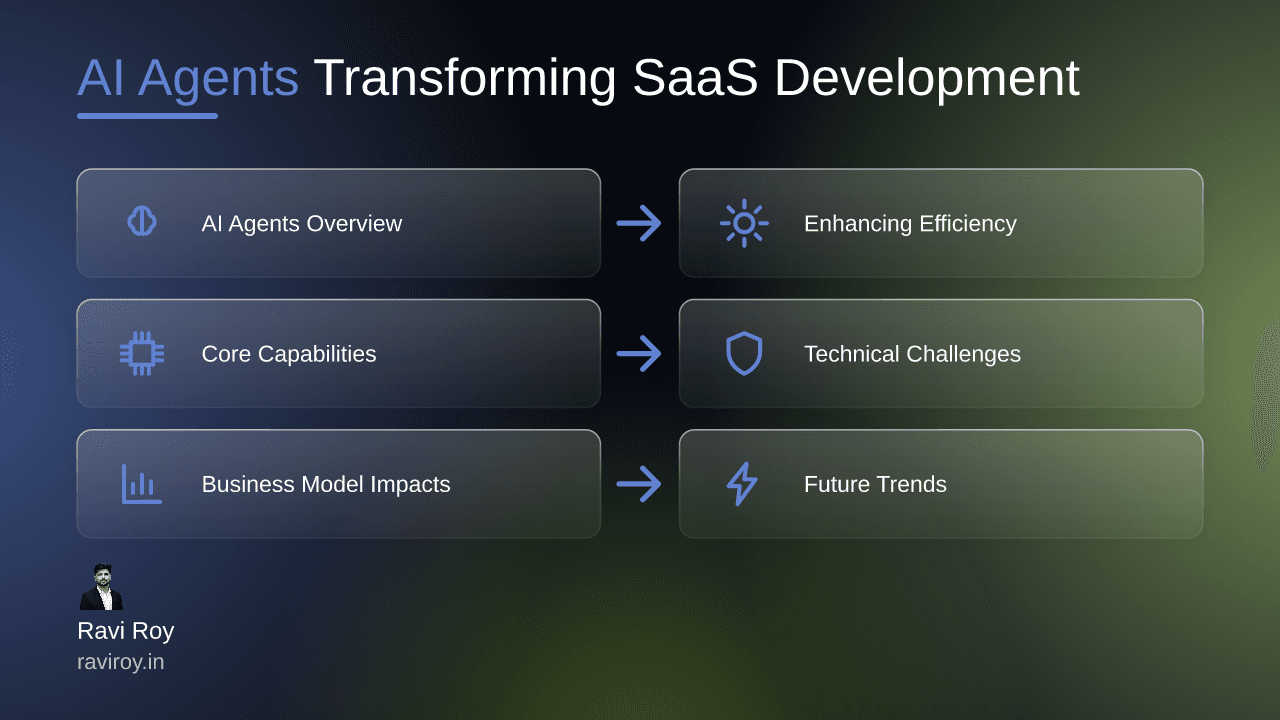
What Are AI Agents in SaaS?
AI agents are software entities equipped with the ability to perform tasks autonomously, utilizing machine learning algorithms and natural language processing to interact intelligently with users and systems. Unlike traditional software, which requires explicit programming for every function, AI agents learn from data, adapting to user needs and enhancing their capabilities over time.
For instance, chatbots in customer support systems exemplify AI agents at work, providing instant responses to inquiries and learning from user interactions to improve over time. In platforms like Salesforce, AI-driven features analyze user behavior to offer proactive recommendations, streamlining workflows and enhancing productivity.
How Do AI Agents Enhance SaaS Development Efficiency?
Accelerated Development Cycles
The integration of AI agents into the development cycle can significantly speed up timelines. Traditional methods often involve lengthy processes of testing and debugging. With AI capabilities, issues can be identified and resolved almost in real-time, allowing teams to release updates faster and stay competitive in an ever-evolving market.
For example, companies leveraging AI-driven tools can reduce their time-to-market by automating routine development tasks like code reviews and integration, enabling project teams to focus on strategizing and feature enhancement.
Improved Software Quality
Quality assurance is often a bottleneck in software development. AI agents can automate testing protocols, predicting potential bugs and offering solutions before they escalate. Using machine learning, these agents can analyze vast amounts of code quickly, identifying patterns and anomalies that might be missed in manual checks.
A notable example is GitHub's Copilot, which assists developers by suggesting code snippets and providing error correction, ensuring that quality is maintained through real-time feedback.
Operational Cost Reduction
AI agents can lead to substantial cost savings through operational efficiencies. Automating repetitive tasks diminishes the need for large teams dedicated to mundane operations, allowing organizations to allocate resources more effectively. For instance, data analysis tasks that traditionally required multiple analysts can now be handled by AI systems, providing insights much faster and at a lower cost.
As a result, a SaaS company can pivot from a reactive to a proactive operational model, leading to significant financial benefits and enhanced growth potential.
Core Capabilities of AI Agents in SaaS Applications
Intent-Based Interfaces
AI agents facilitate user engagement through intent-based functionalities, making systems more intuitive. By understanding user queries and predicting needs, AI agents create seamless interactions. Tools such as voice-activated assistants mirror this capability, making it easier for users to communicate with software without needing extensive training.
This user-focused design can transform user satisfaction, as software becomes more adaptable to individual preferences and workflows.
Low-Code and No-Code Solutions
The rise of low-code and no-code platforms driven by AI agents is democratizing software development. With visual interfaces and AI-assisted capabilities, non-technical users can contribute to product development, thus accelerating innovation cycles.
For example, platforms like Bubble and Airtable allow users to create applications with minimal coding knowledge, enabling a broader range of stakeholders to contribute to the process and reducing reliance on specialized developers.
Hyper-Personalization
AI agents are at the forefront of hyper-personalization efforts, tailoring user experiences based on individual behavior and preferences. By analyzing user data, these agents can suggest features and functions that are most relevant, enhancing engagement and satisfaction.
Such features are evident in applications like Spotify, which leverages AI to curate personalized playlists based on listening habits, transforming user interaction into a more engaging experience.
Navigating Technical Challenges in AI Agent Integration
Data Privacy and Security
With great power comes great responsibility. The deployment of AI agents raises significant concerns about data privacy and security. Organizations must ensure compliance with regulations like GDPR and CCPA while implementing AI systems that handle sensitive user data.
Implementing robust encryption methods and adopting ethical AI practices is crucial to safeguarding user information while still leveraging the benefits of AI.
System Compatibility
Integrating AI agents within existing infrastructure can pose challenges, particularly with legacy systems that are not designed to support modern AI functionalities. A thorough assessment of current technology ecosystems is necessary prior to implementation, ensuring smooth transitions and optimal compatibility.
Collaboration with IT specialists and phased rollouts can aid in addressing potential integration challenges effectively.
Scalability Issues
As demand for SaaS products increases, scaling AI agents becomes imperative. Organizations must design their AI solutions with future growth in mind, choosing scalable architectures that can adapt as user bases expand. Cloud-based solutions often provide the necessary flexibility, enabling rapid scaling of resources as needed.
Planning for scalability from the onset can save organizations time and money in the long run, ensuring that AI capabilities grow in tandem with their objectives.
Impacts of AI Agents on SaaS Business Models
Redefining Pricing Structures
AI agents are reshaping traditional subscription models, paving the way for usage-based pricing strategies. By analyzing user behavior and product engagement, businesses can tailor their pricing, charging users based on actual usage rather than flat-rate fees.
This shift allows for more competitive pricing while simultaneously enhancing revenue potential for providers who can better align their offerings with user needs.
Creating New Value Propositions
AI agents enable SaaS businesses to offer innovative value propositions that were previously unattainable. From predictive analytics to proactive customer service, these agents create unique differentiators in crowded markets.
Examples include implementing AI-driven insights that can help businesses make informed decisions about product features or marketing strategies, enhancing their competitive edge.
The Future Trends of AI Agents in SaaS
Shift to Autonomous Operations
The future points towards an increasing shift towards autonomy, where AI agents will take on more responsibility in managing not just development tasks but entire operational processes. This could enable organizations to function more efficiently, with AI systems autonomously handling routine tasks and decision-making processes.
Proactive User Experiences
As AI capabilities evolve, user experiences are becoming increasingly proactive. Systems will no longer wait for user queries but will engage users based on predictive insights, offering assistance before an issue even arises. This trend towards anticipation in user interactions will transform customer support and overall engagement strategies.
Conclusion and Discussion
AI agents are not just another tool in the tech stack; they represent a paradigm shift in how SaaS product development is approached. By automating processes and enhancing capabilities, AI agents are positioning businesses for a future characterized by rapid adaptation and innovation.
As we witness the ongoing transformation, we invite you to share your insights. How have you seen AI agents impact SaaS product development in your own work?
💬 Join the conversation — share your take in the comments and tell us what you’d add.